

Your body contains cells that no longer work normally, no longer divide and refuse the order to die. They can linger for years, taking up space and releasing chemical signals that disturb healthy neighbours. Scientists call them senescent cells. Everyone else found a better name: zombie cells.
A cell does not become senescent — or zombie-like — because it has decided to ruin your retirement. It usually happens after serious DNA damage, too many divisions or another danger signal. The cell pulls an emergency brake and stops multiplying. It is a useful defence, because a damaged cell that continues copying itself may become a tumour.
What changes with age is the cleaning service. Our defences become less efficient, damaged cells appear faster than they can be removed and some learn to resist cell death. The US National Institute on Aging puts it plainly: they stop multiplying, linger in tissue and release substances that can trigger inflammation. A protective tool becomes a tenant that pays no rent, refuses to leave and annoys the entire building.
The signals they release promote chronic inflammation, scarring and fresh senescence nearby. Their accumulation has been linked to frailty, pulmonary fibrosis, osteoarthritis and neurodegenerative processes. Zombie cells are not the sole cause. Ageing is a stack of different breakdowns, but they are one of its clearest pieces.
One experiment is particularly hard to ignore. In a study published in Nature Medicine, transplanting a small number of senescent cells into young mice was enough to reduce their speed, strength and endurance. The cells did not merely sit there; they spread dysfunction into other tissues.
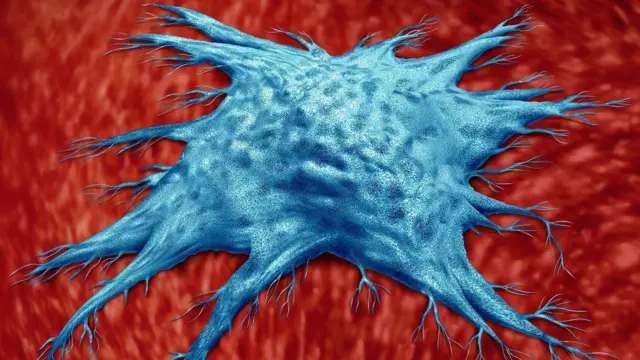
Senolytics are a clean-up crew with a target list
This is where senolytics come in. These drugs are designed to force senescent cells to complete the step they have avoided for years — in other words, to die and let the body remove them. They do not try to make every cell young or rewrite its identity, as partial reprogramming with Yamanaka factors does. Their job is closer to that of a clean-up crew carrying a target list.
The best-known combination pairs dasatinib, a drug used against certain cancers, with quercetin, a compound found in fruit and vegetables. Researchers are also studying fisetin and medicines that quiet harmful secretions without killing the cell, known as senomorphics.
In old mice, intermittent doses of dasatinib and quercetin reduced the burden of senescent cells, improved physical function and increased remaining survival after treatment by 36 per cent. That is a huge result and still, crucially, a result in mice. Medical history is crowded with animals that recovered before the same idea stumbled in humans.
That does not mean you should buy quercetin and run the experiment at home. A supplement is not a clinical treatment, and dasatinib has serious side effects and interactions. Self-medicating remains a remarkably inventive way to volunteer as the guinea pig.
Human evidence still begins with fourteen patients
The first published human trial arrived in 2019. Fourteen people with idiopathic pulmonary fibrosis received dasatinib and quercetin for three weeks. Some physical measures improved, but the study was small, had no placebo group and focused primarily on whether treatment could be administered. It opened a path, but it did not prove rejuvenation. A biological age test would not prove it on its own either, because moving a marker does not show that someone's health has improved.
Trials now cover bone health, cognitive decline and kidney disease. One on ClinicalTrials.gov compares dasatinib plus quercetin, fisetin and an untreated group. The work has reached humans, although researchers are still learning what to remove, how much and at what cost.
The zombie label hides the main difficulty, because there is no single type of senescent cell. Cells in the lung, brain and fat can release different signals and respond in opposite ways to the same drug. An indiscriminate pill might clear harmful cells and take out others repairing a wound.
A map of zombie cells may matter more than another pill
In June 2026, the US National Institutes of Health's SenNet consortium presented the first large-scale atlas of human senescent cells. It has charted populations in tissues including the lung, lymph nodes and the brain's prefrontal cortex, while building a catalogue across fourteen cell types.
Researchers are using single-cell analysis, spatial maps and machine learning to recognise their different profiles. That work may allow the next generation of senolytics to stop firing at an entire category and target the exact population damaging an organ. The NIH-funded atlas does not sell an immediate cure. It provides something any cure would need: the location and identity of its target.
Clearing senescent cells will not make us immortal. Mutations will remain, telomeres will keep shortening and mitochondria will still fail. That is why this approach fits longevity escape velocity: one treatment need not fix everything if enough repairs can buy time for the next one.
I do not see ageing as a moral lesson we should solemnly accept. It is a biological process made of specific forms of damage, and specific damage can be studied. We are already trying to return human cells to a younger state inside the eye, and learning to remove cells stuck in the wrong state is the other side of the same problem.
No senolytic is approved or available today to slow human ageing. If a supplement promises to clear your zombie cells, ask for the human trial that proves it.
The conversation starts here
Sign in with a supporter account to comment. Sign in


Nobody has commented yet. Want to go first?