

A living glossary
How to use this gaming dictionary
You do not need to memorise the language of an entire hobby. Turn the pages, jump straight to a chapter or find the term that stopped you. Every entry has its own space, with links to fuller explanations whenever one definition is not enough.
Industry and genres
- AAA, AA and indie
- AAA and AA informally describe production scale and budget. Indie refers to independence, not necessarily a small project. None is a quality score.
- Early access
- a game sold before completion to fund and test development.
- DLC
- additional downloadable content for a game. It may be free or paid and can appear on launch day.
- Expansion
- a substantial content addition, usually larger than a minor add-on. An expansion can also be distributed as DLC.
- Live service
- a game built to receive seasons, events and purchases over several years.
- Port
- adaptation to another platform.
Industry and genres
- Remaster
- improves an existing game.
- Remake
- rebuilds it extensively.
- Reboot
- restarts a series' direction. Marketing uses these borders loosely.
- RPG
- role-playing game built around character progression and choices.
- ARPG
- an RPG focused on real-time action.
- JRPG
- a role-playing tradition associated with Japan, not a rule that combat must use turns.
Industry and genres
- CRPG
- computer and tabletop-inspired role-playing with many decisions and statistics.
- Roguelike
- a game of repeated runs, rule-generated environments and severe consequences for dying.
- Roguelite
- some permanent progress survives between attempts. The boundary is not absolute, as our guide to roguelikes and roguelites explains.
- Metroidvania
- a connected map that opens as the player gains new abilities.
Combat, roles and numbers
- Soulslike
- demanding combat, recoverable resources after death and pattern learning.
- Extraction shooter
- enter, collect loot and escape alive to keep it.
- Battle royale
- many players, shrinking space and one final survivor or team.
- DPS
- damage per second. The same abbreviation can describe a role devoted to dealing damage.
- Tank
- absorbs pressure and protects the team.
- Support
- helps through healing, control or buffs.
Combat, roles and numbers
- Aggro
- an enemy's attention.
- CC
- crowd control such as a stun or immobilisation.
- AoE
- an effect that covers an area instead of one target.
- Cooldown
- wait before reusing an ability.
- DoT
- damage over time.
- Burst
- heavy damage in a short window.
Combat, roles and numbers
- Proc
- an effect triggered by a condition or chance.
- Crit
- critical hit.
- I-frames
- moments of invulnerability during an animation.
- Hitbox
- invisible volume of an attack that marks where it can connect.
- Hurtbox
- area of a character or object that can receive that attack.
- Frame data
- number of frames a move needs to start, connect and recover.
Combat, roles and numbers
- Buff
- an improvement to a statistic, character, weapon or ability. It can be a temporary in-match effect or a balance change in an update.
- Nerf
- reduction in power.
- Rework
- wider redesign.
- Meta
- the strategies and choices that perform best in the current environment. They are not mandatory.
- Tier list
- subjective ranking by strength.
- OP
- overpowered.
Combat, roles and numbers
- Broken
- so strong or defective that expected balance collapses.
- Cheese
- simple or inelegant tactic exploiting a weakness.
- Min-max
- sacrifice secondary areas to maximise important ones.
- Build
- combination of gear, statistics and abilities.
- Power creep
- new content gradually makes old options irrelevant.
- Patch
- update.
Combat, roles and numbers
- Hotfix
- an urgent correction released outside the normal update cycle. It is not defined solely by its size.
- Balance pass
- broad adjustment of numbers.
Online play, ranked and matchmaking
- Lobby
- group of players gathered for a match.
- Matchmaking
- the system that creates that match.
- MMR
- a value estimating skill for matchmaking. It may be hidden or differ from the visible rank. TrueSkill 2 is one example of a rating system.
- Elo
- rating developed for chess. In games, people often use the name for almost any rating.
- Ranked
- mode with visible ranks and changes.
- SBMM
- skill-based matchmaking. It is not a machine deciding when a player must lose. Activision's matchmaking paper gives connection the greatest weight. Our guide explains how SBMM works and why it annoys players.
Online play, ranked and matchmaking
- Ping
- time taken for data to travel from a device to the server and back.
- Tick rate
- how often the server updates the match.
- Lag
- perceived delay, often network-related.
- Packet loss
- data that never arrives.
- Desync
- the game on your device and the server disagree about what happened.
- Smurf
- expert's secondary account facing low levels.
Online play, ranked and matchmaking
- Boosting
- manipulating a rank upward.
Display, performance and response
- FPS
- frames per second or first-person shooter. The surrounding sentence tells you which one applies.
- Frame time
- milliseconds needed to produce one frame. A high average frame rate can still feel poor when those times are uneven.
- Stutter
- brief hitch.
- Frame pacing
- regularity of frame delivery.
- V-Sync
- synchronises the game and display to stop tearing, sometimes at the cost of extra delay.
- VRR
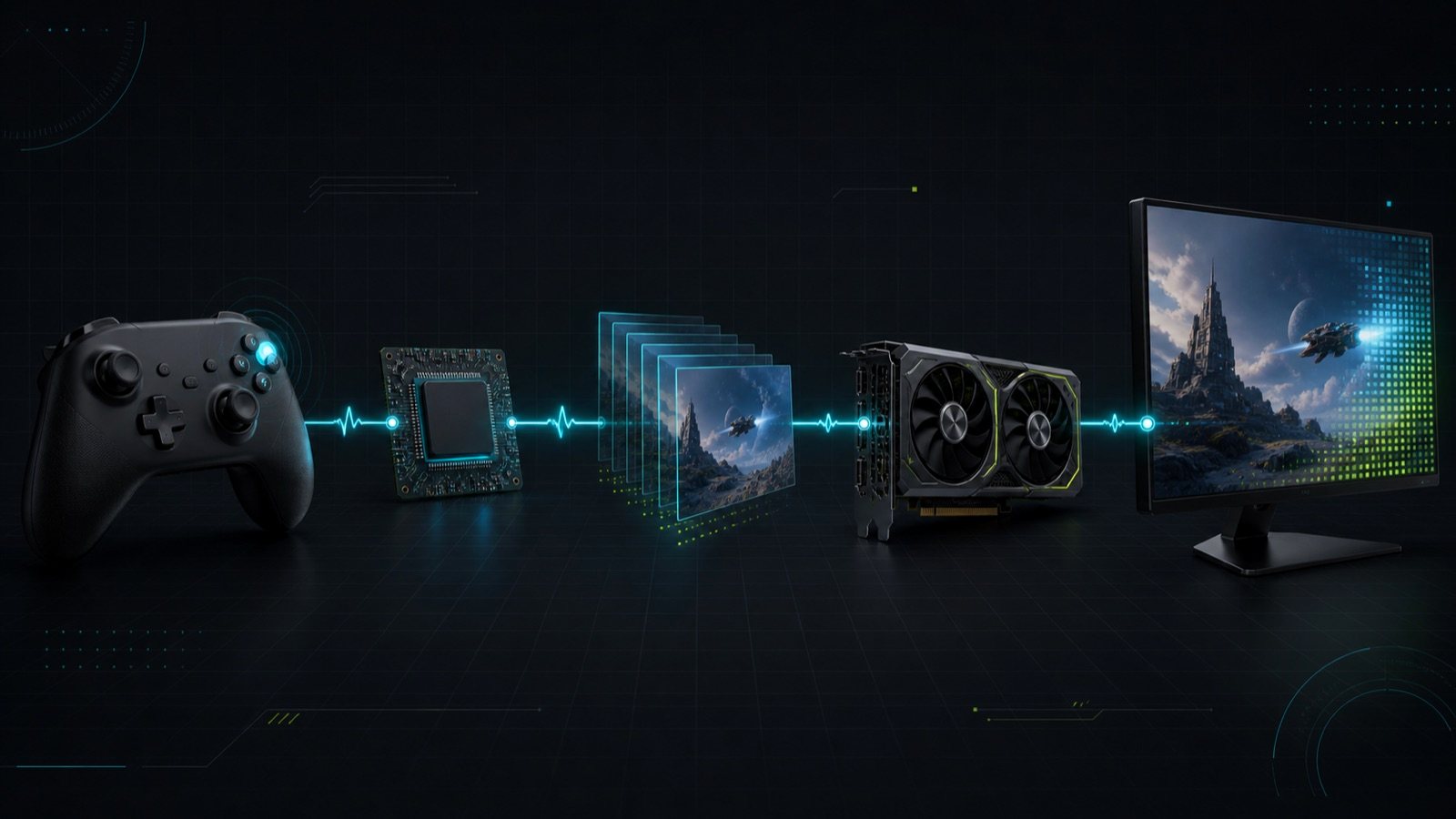
- variable refresh rate. The display adjusts its rhythm to match the console or PC. VRR, G-Sync and FreeSync explains each label.
Display, performance and response
- 120 Hz
- a display can refresh 120 times per second. The game may still produce fewer than 120 FPS.
- Input lag
- time between an action and its visible result.
- Latency
- general term for any delay. Our input lag guide separates the delay added by the controller, engine, GPU and TV.
- FOV
- field of view.
- Motion blur
- blur added to movement.
- CPU bound
- the processor limits performance.
Display, performance and response
- GPU bound
- the graphics hardware limits it.
- Bottleneck
- the component setting the ceiling in a particular task. Every system has one. Use our guide to check whether a game runs on your PC when a requirements list becomes difficult to interpret.
- DPI
- number of movement counts a mouse sensor records per inch. A higher number is not automatically better.
- Polling rate
- number of reports a peripheral sends each second.
- Dead zone
- stick movement that the system ignores to prevent unintended input.
- Drift
- movement registered without touching the stick.
Display, performance and response
- Mechanical switch
- uses physical contacts.
- Hall Effect
- magnetic position sensing with adjustable actuation. We compare magnetic and mechanical keyboards.
- Rapid Trigger
- lets a key activate as it moves down and reset as soon as it rises, without waiting for fixed actuation and reset points.

Monetisation and community
- F2P
- free-to-play, with no initial purchase required.
- Premium
- a game bought upfront rather than offered free-to-play.
- Battle pass
- reward track divided into tiers.
- Loot box
- container with a random result.
- Gacha
- system of random pulls for characters or items.
- P2W
- payment grants a competitive advantage that is difficult to earn by playing.
Monetisation and community
- Cosmetic
- visual item with no intended rules effect.
- Whale
- player spending heavily.
- FOMO
- fear of missing a temporary reward.
- Grind
- repeated play required to progress.
- Time gate
- enforced wait.
- GG
- good game.
Monetisation and community
- GLHF
- good luck, have fun.
- AFK
- away from the keyboard or inactive.
- DC
- disconnect.
- Rage quit
- leaving in anger.
- Toxic
- behaviour that harms other players' experience.
1 / 20
You can also use the left and right arrow keys.
00
The conversation starts here
Sign in with a supporter account to comment. Sign in
Nobody has commented yet. Want to go first?