

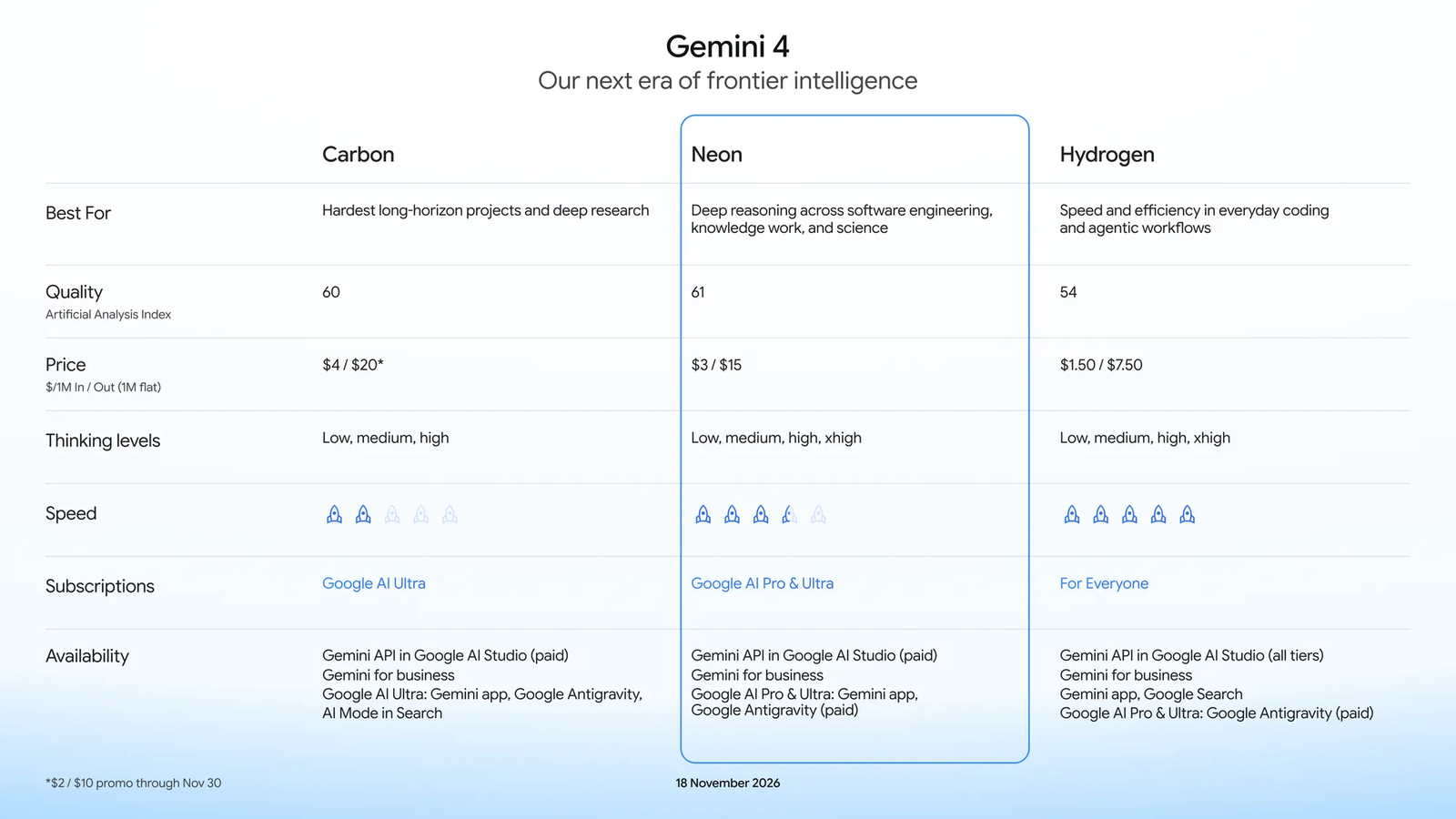
Google on Wednesday, Nov. 18, released Gemini 4 Neon, a new AI model for Gemini app users who pay for Google AI Pro ($19.99 a month) or AI Ultra. Developers can also reach it through the paid tier of the Gemini API, the pay-as-you-go service for plugging Google's models into their own software, at $3 per million input tokens and $15 per million output tokens. Tokens are the chunks of text a model reads and writes.
Neon sits in the middle of the Gemini 4 lineup. Google pitches Carbon for its hardest, longest projects and Hydrogen for quick everyday work. Neon is meant for complex coding, data analysis and the kind of business work teams run over and over, where speed and cost matter as much as getting the answer right.
What Neon is, and where Argon went
Google's model card says Neon was adapted from Gemini 4 Carbon, the company's most capable model. It takes text, images, audio and video, handles up to a million tokens of combined input and output, and its knowledge stops at March 2026. Neon has four thinking levels (low, medium, high and extra high, labeled xhigh), which set how long it reasons before answering. High is the default.
Until now, AI Pro's top model was Gemini 4 Argon. Google doesn't mention Argon in the Neon announcement or in its chart of the Gemini 4 family, and the U.S. plans page now lists AI Pro with Neon and Hydrogen only. Google hasn't said whether Argon is leaving the app's model picker. It's still on the API price list.
Who can use it
In the Gemini app, Neon is rolling out to AI Pro and to AI Ultra, which starts at $99.99 a month. Subscribers on those plans also get it in Antigravity, Google's coding tool where AI writes and tests code on its own. Developers can use it through the paid API in AI Studio and Android Studio, and businesses through Gemini for business. The free tier and the $4.99 AI Plus plan stay on Hydrogen.
Google also says Tasks, the app mode that handles multistep errands like figuring out why a utility bill spiked, can now run on Neon. Tasks went free in the U.S. on Nov. 17 with Hydrogen, and Google hasn't said how the app decides which of the two models takes a given job. The rollout is gradual, so Neon may take a few days to show up in your model picker.
API pricing next to Argon, Carbon and GPT-6.2
Google doesn't describe Neon's prices as introductory, unlike those of Argon and Carbon, which charge $2 and $10 through Nov. 30 and then $4 and $20 from Dec. 1. Per token, that makes Neon 50% more expensive than its siblings today and 25% cheaper in December. Hydrogen costs $1.50 and $7.50, half of Neon. When an app resends the same text with every request, such as a fixed set of instructions, Neon bills that cached input at $0.15 per million tokens instead of $3.
Take a job that reads a million tokens and writes 200,000. It costs $6 on Neon, $4 on Argon or Carbon this month and $8 starting in December, and $3 on Hydrogen. At OpenAI, GPT-6.2 Astra, priced at $8 and $40, comes to $16, while GPT-6.2 Sol comes to $4. Those are per-token prices, not per-task costs. Each model burns a different number of tokens on the same problem, and Carbon in particular explores more paths before it answers.
What Google says improved
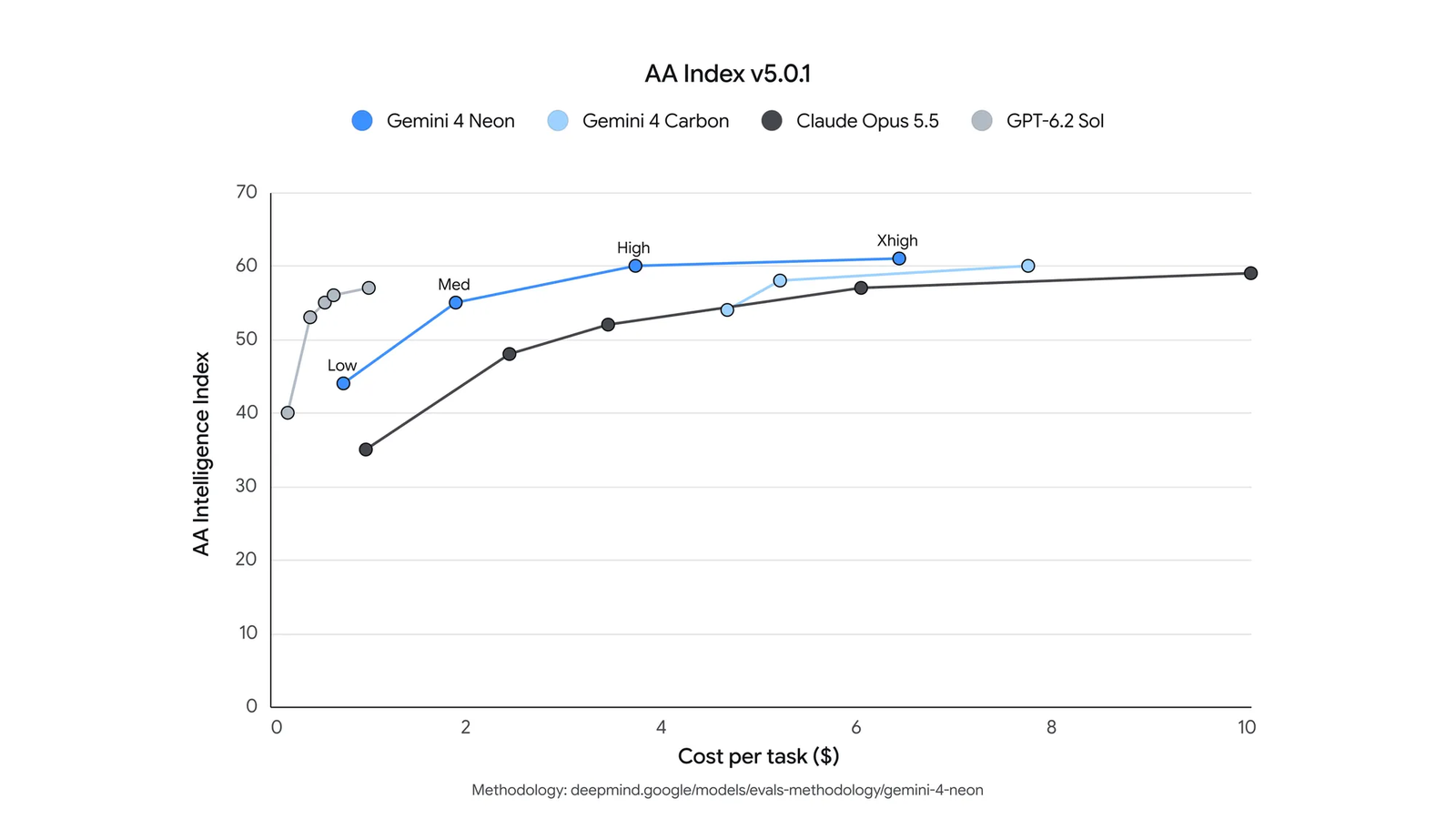
Google says Neon at its high setting costs 32% less per task than Carbon. On the Artificial Analysis Intelligence Index, an outside ranking that blends several tests, Google credits Neon with 61 points at xhigh, versus 60 for Carbon and 54 for Hydrogen, good for third place overall. On the Vals Index, which measures professional tasks in coding, finance and law, it ranks second at 70.9%.
Google's own cost-per-task chart also shows where Neon isn't the bargain. GPT-6.2 Sol reaches about 57 points on that index for roughly $1 a task, while Neon needs close to $4 to hit 60 at its high setting. If a job doesn't need top-tier reasoning, cheaper options get close.
Google also says Neon fabricated results less often than any of its previous models in internal Antigravity testing, without publishing the number, and that it took shortcuts on just 2.45% of tasks of a coding test built to catch cheating, the lowest of any Gemini 4 model. Both are in-house measurements that no one outside Google has reproduced yet.
The conversation starts here
Sign in with a supporter account to comment. Sign in


Nobody has commented yet. Want to go first?