
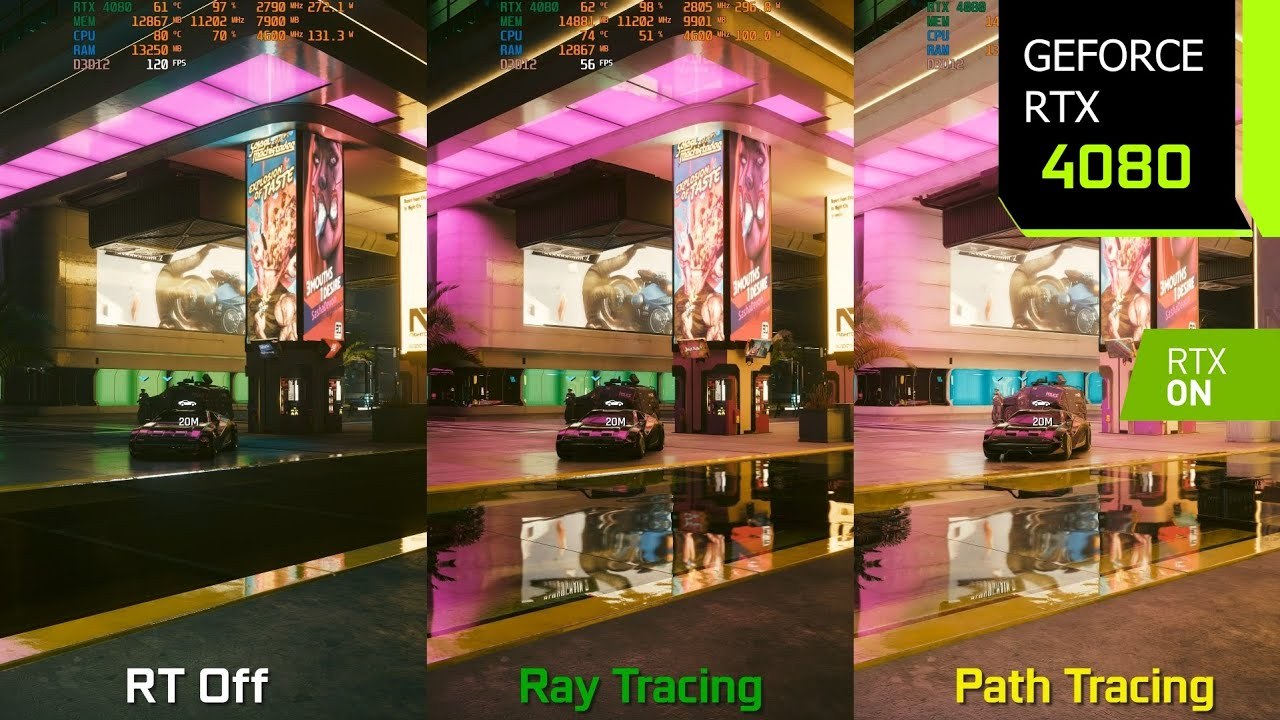
It's raining in Night City, you stop the bike in front of a shop window, pink neon spills across the puddle on the pavement and there it is, your reflection, whole, moving with you. A few years ago that puddle was a lie, a painted reflection that vanished the moment you turned the camera. Today it's the product of your graphics card firing millions of light rays and chasing every bounce. That, in short, is ray tracing, and here we'll look at what it actually does, why it makes any GPU sweat and when it's worth turning on.
30 years of building a set
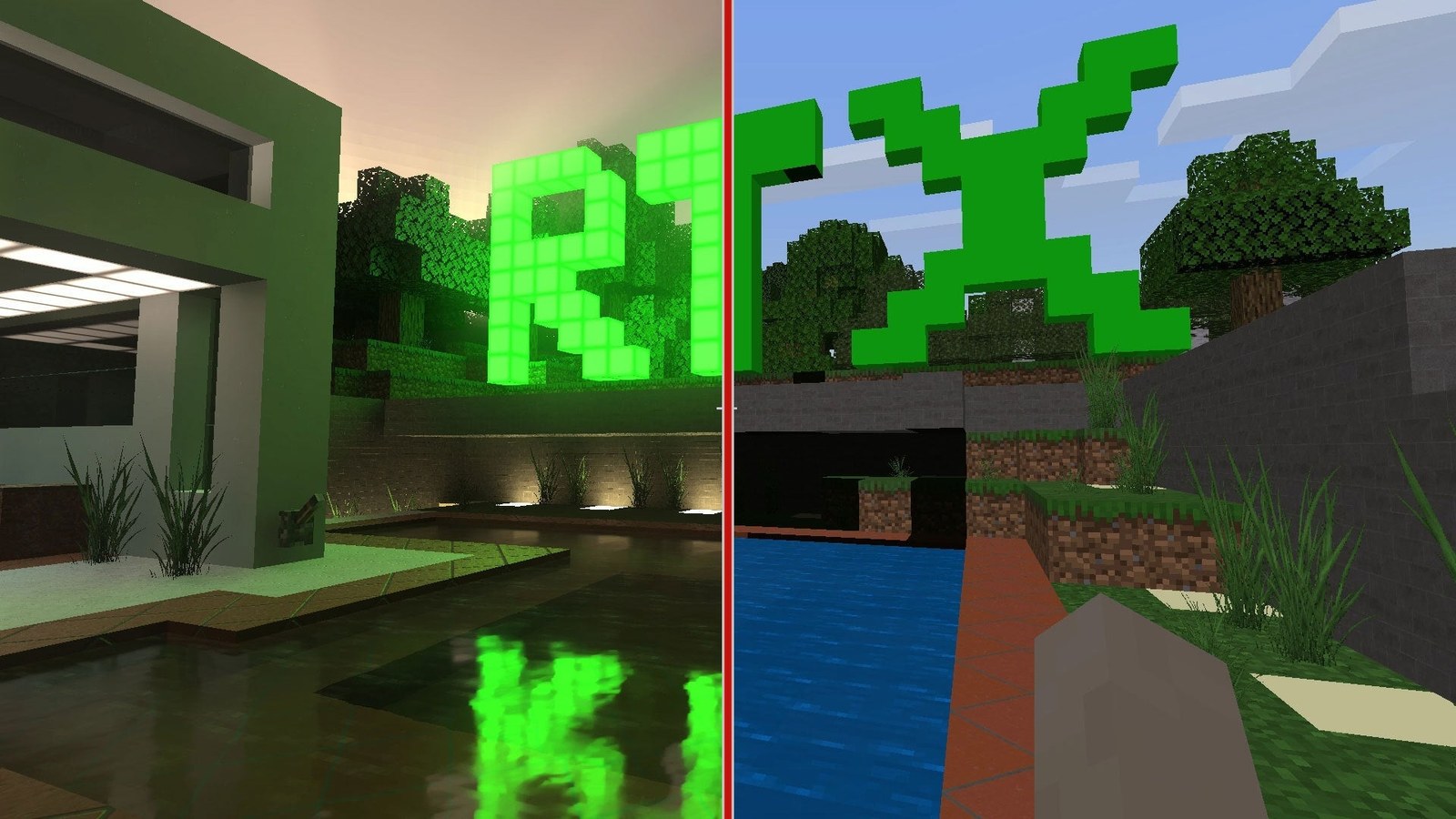
The technique behind almost every game you've ever played is called rasterisation, which boils down to turning 3D geometry into pixels and painting the lighting on top. And I mean painting literally. Building shadows are usually computed in advance and stuck to the scenery like a decal. Reflections are screen-space reflections, a trick that can only mirror what's already on screen. The world you're walking through is, deep down, a stage set with the lighting pinned in place.
And it works. It has worked beautifully for 30 years, not least because it's dirt cheap to compute. But the set has seams, and you've seen them a thousand times, mirrors you don't appear in, shadows that never move with the sun, rooms lit with no light coming in from anywhere. Your eye can't always name what's wrong, but it knows something is.
What ray tracing actually does
Ray tracing computes lighting by simulating how light physically behaves: it fires rays from the camera into the scene, follows their bounces off every surface and uses them to decide the colour of each pixel. Light stops being painted onto the set and gets calculated in real time.
The elegant bit is that it works backwards from nature. In the real world, rays leave the bulb and a lucky few end up in your eye, computing all of them would be absurd, because almost none reach you. So the algorithm fires rays from the eye (the camera) outwards, tracing back where that light would have come from. Bounce by bounce, the puddle mirrors the neon because a ray travelled from puddle to billboard, and the room turns red because light bounced off a red curtain. When every bounce of every light gets computed, the technique is called path tracing, the maddest version of the idea.
The idea comes from cinema, which has used it for decades. The difference is that a server farm can spend hours rendering a single frame of a Pixar film, and your console gets 16 milliseconds to do the same job. That's the problem, and everything else follows from it.
From rich kids' toy in 2018 to a requirement
NVIDIA added ray tracing to consumer cards in August 2018 with the RTX 20 series, and the debut was anything but triumphant, they cost a fortune, a handful of games used it, and the very first, Battlefield V, became famous for gorgeous puddles that ate half your frame rate. For a couple of years, ray tracing was PC gaming's expensive joke.
Two things saved it. First, AI: techniques like DLSS and FSR render the game at a lower resolution and let a neural network invent the missing pixels, handing back the frames ray tracing devours. Without that move, this would still be a slideshow. Second, consoles: PS5 and Xbox Series have shipped with it since 2020, and even Switch 2 carries the hardware, so studios no longer design for the exception, they design for the norm.
The wheel has now turned completely. Metro Exodus shipped the first mandatory-ray-tracing edition in 2021, Indiana Jones and the Great Circle did the same in 2024 and Doom: The Dark Ages simply won't boot without a compatible GPU. It's no longer a menu extra, it's the fine print in the minimum specs.
Is it worth turning on?
The shot at the top of this piece was taken on an RTX 4080 at the exact same corner of Cyberpunk 2077: 120 fps with ray tracing off, 56 with full path tracing. Real light costs you, quite literally, half your frames.
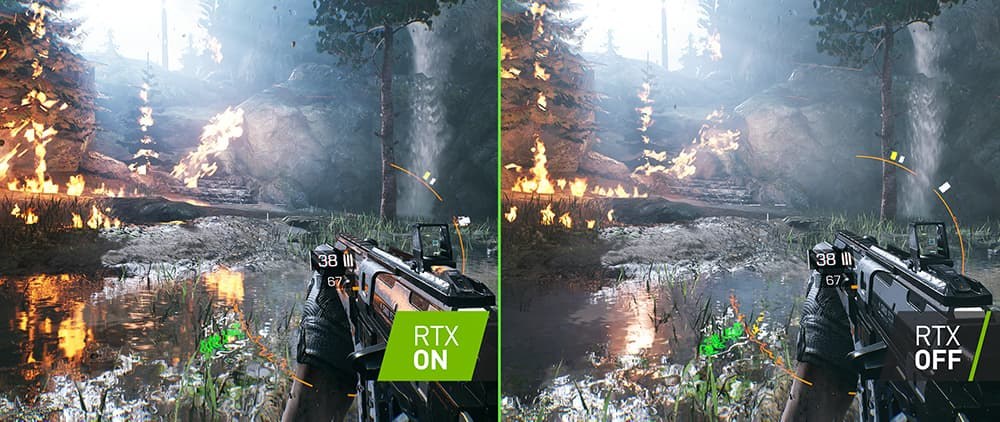
My advice after years of fiddling with these menus, reflections and global illumination are what you actually notice, so switch them on if your rig can take it, ray-traced shadows are barely distinguishable from the regular kind and rarely earn their cost, and full path tracing remains high-end territory, as PC Gamer points out with Doom. On console the choice is made for you, performance mode or quality mode, and everyone has their religion there (mine, in shooters, is performance every time).
Want to see it with your own eyes without spending a euro? Metro Exodus joins the PS Plus Game Catalog on August 18 with ray tracing built into its PS5 edition. Turn on a torch in a Moscow metro tunnel and tell me the set doesn't look different. And if these plain-language explainers are your thing, we've also covered what ChatGPT tokens are and what stem cells are.
The conversation starts here
Sign in with a supporter account to comment. Sign in

Nobody has commented yet. Want to go first?