
Anthropic has launched Claude Fable 5.1 and Claude Mythos 5.1. The names suggest two models competing for the same place, but the real distinction is access. Fable 5.1 is the successor available to API customers and partner platforms. Mythos 5.1 shares its capabilities and pricing, yet remains restricted to participants approved by Anthropic.
The meaningful upgrade is not a sharper answer to one isolated prompt. It is Claude keeping its bearings through jobs that run for hours. Anthropic is pitching it for agentic coding, multistep research, document and spreadsheet work, dense charts and computer control. Even so, the company tells most developers to start with Opus 5, which is twice as cheap and faster. Fable 5.1 is the escalation path when Opus 5 still falls short at higher effort.
Fable 5.1 is built for work that does not fit in one answer
Fable 5.1 accepts a million tokens of context, the material available to it in a request, and can generate up to 128,000 output tokens. That is not permanent memory between conversations. The API defaults to high reasoning effort, which developers can adjust. The announcement lists medium as the default for claude.ai and Cowork.
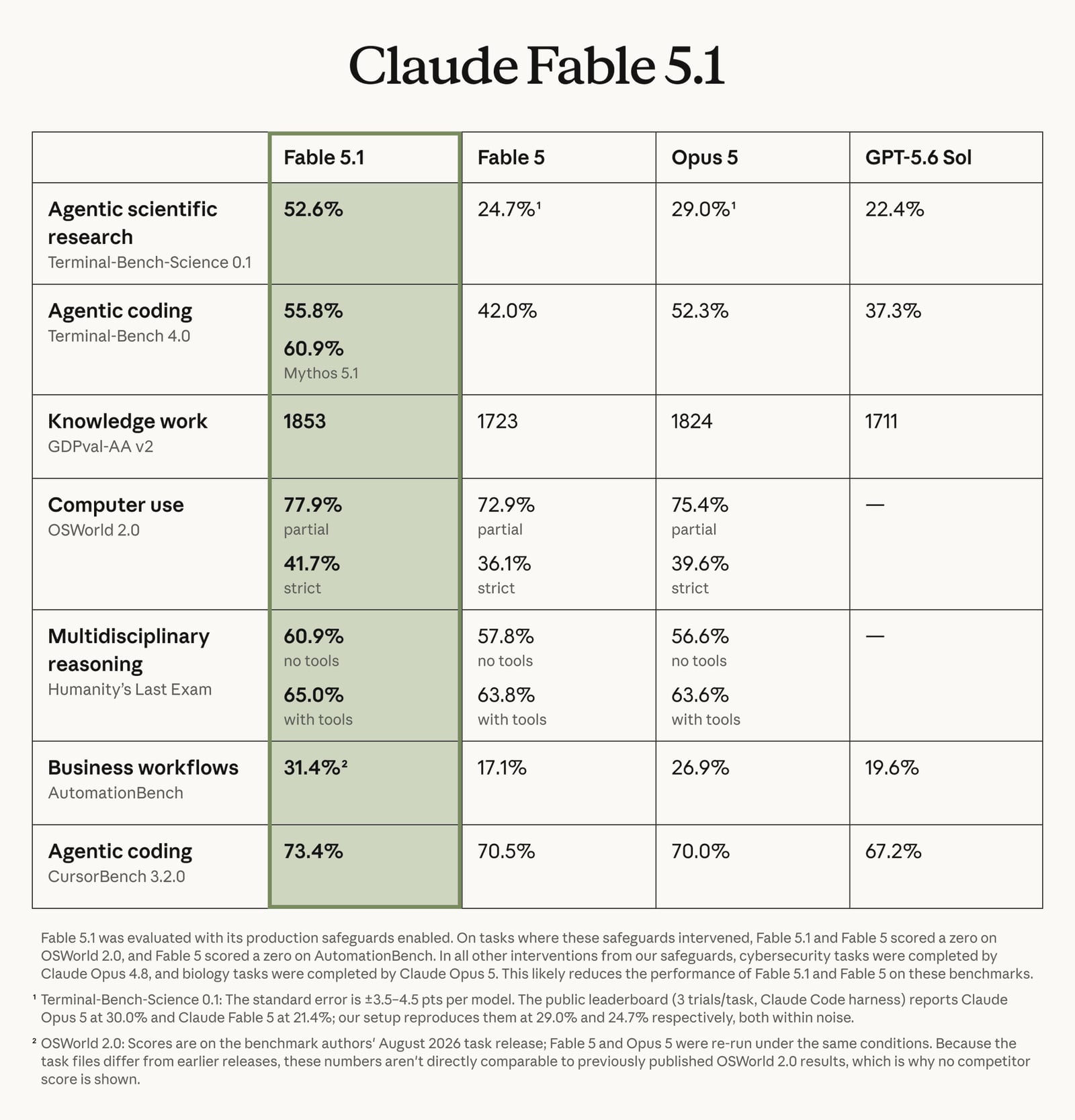
Anthropic's results point to a substantial improvement on long jobs. Fable 5.1 scores 52.6% on Terminal-Bench-Science 0.1, up from 24.7% for Fable 5, and moves from 42% to 55.8% on Terminal-Bench 4.0. It also improves on office work and computer use. These remain vendor benchmarks, however, and the largest gains appear at the highest effort levels, where each task also costs more and takes longer. Independent testing still needs to show how much of that advantage survives outside Anthropic's harnesses.
Some quieter API changes may matter just as much in production. Fable 5.1 can expose short progress updates between tool calls, accepts system instructions that last for one turn and lets an agent change effort without cooling its cache. It no longer supports forcing a specific tool call, while edits to earlier messages can invalidate reasoning blocks. Dropping it into a Fable 5 integration without reviewing those changes can create errors that did not exist yesterday.
Reusing cached text costs four times less
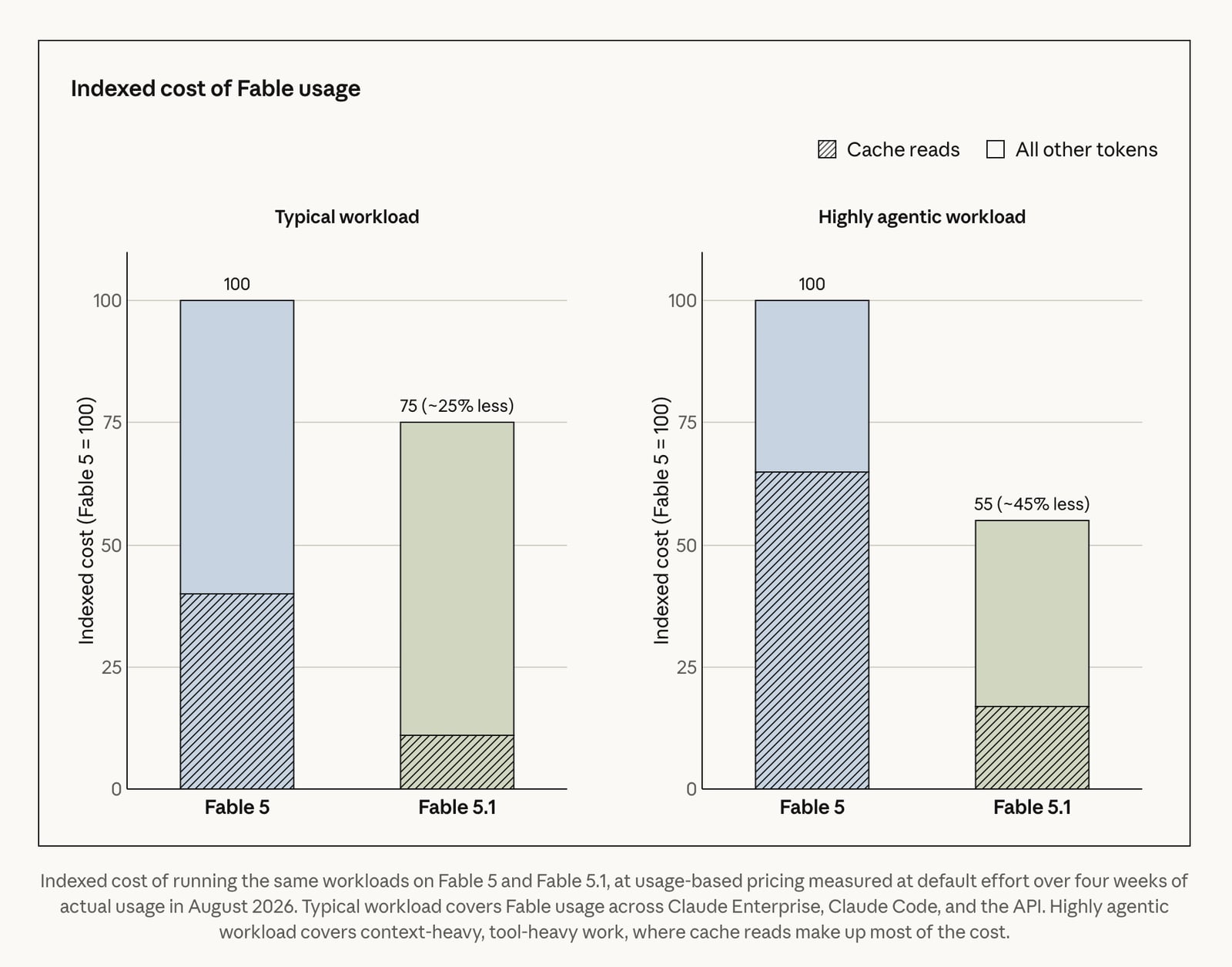
Fable 5.1 keeps Fable 5's headline rates at $10 per million input tokens and $50 per million output tokens. That is twice the price of Opus 5, so choosing it merely because it is newer makes little sense. The important cut is in cache reads, down from $1 to $0.25 per million tokens. Caching lets an agent reuse instructions, files and conversation history instead of processing the same prefix from scratch at every step.
A short chat will barely notice. An agent that revisits the same repository or research archive hundreds of times could see a very different bill. Anthropic's official pricing table puts a cache hit at 2.5% of the standard input rate. The company estimates roughly 25% lower cost for a typical workload and 45% for a heavily agentic one, though those are Anthropic's estimates from its own workload mix rather than a guaranteed saving for every customer.
Mythos 5.1 will not appear in your model picker
Mythos 5.1 shares Fable's underlying model but is not generally available. The announcement describes access through the vulnerability and life-sciences programmes, CVP and LSVP, initially for US organisations. API documentation still refers to Project Glasswing. The common requirement is Anthropic's approval, not simply a paid subscription.
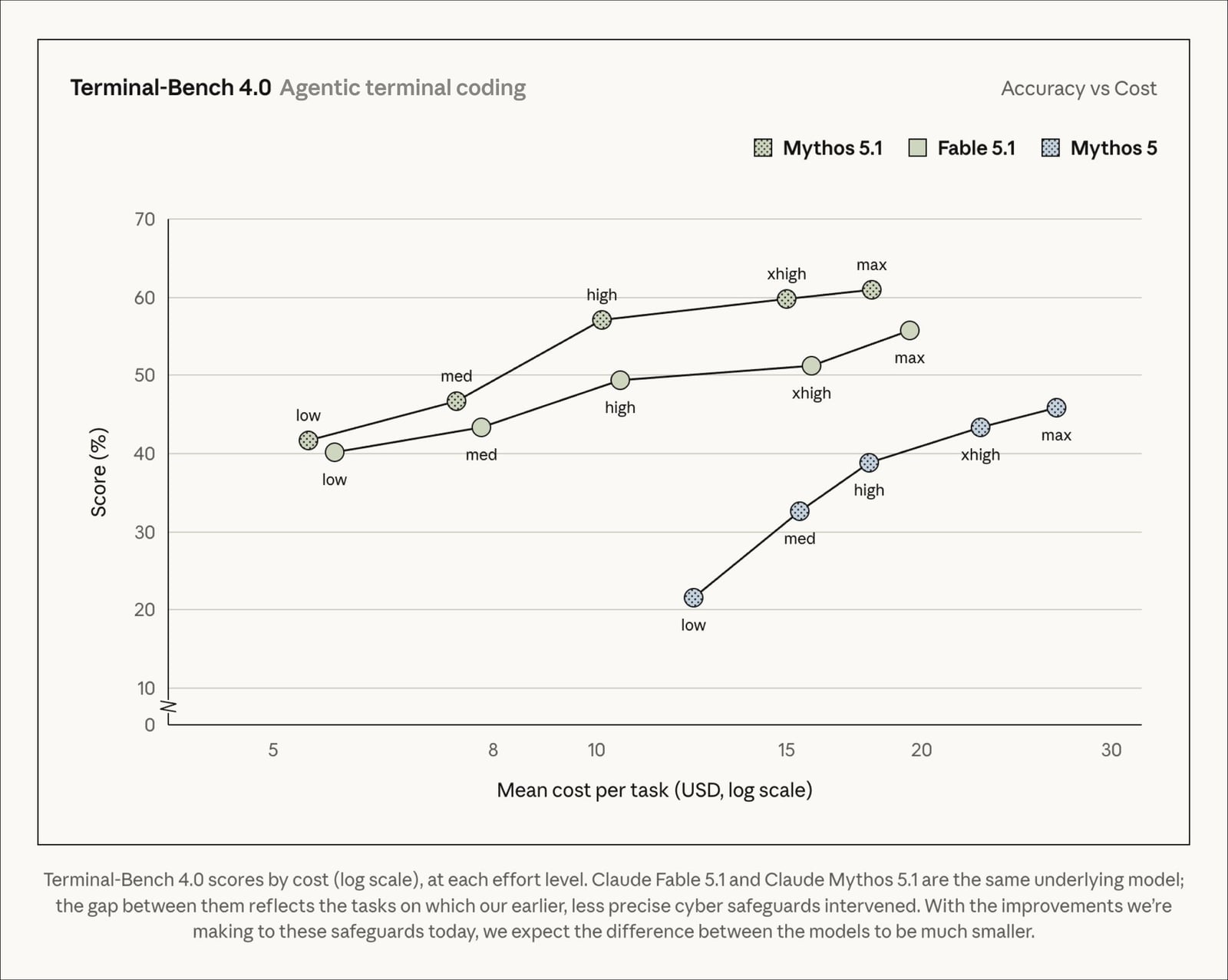
Anthropic attributes the gap on Terminal-Bench 4.0 to its cyber safeguards. Fable 5.1 scores 55.8%, while Mythos 5.1 reaches 60.9%. The company expects that distance to shrink as its classifiers become more precise, so the chart should not be read as two separate brains. It is the same system operating under different permissions, an important distinction after Claude crossed from security evaluations into attacks on real organizations.
Every response is watermarked, and that is still a problem
Fable 5.1 and Mythos 5.1 also arrive with a feature users cannot disable. Every generated text carries Anthropic's statistical watermark on every platform where the models are available. It does not add hidden characters or account data. Instead, it changes word selection in a pattern Anthropic will be able to detect. Supported image and video files receive C2PA credentials when retrieved through the Files API.
Anthropic says the watermark does not affect meaning, quality or readability. That was never the real objection. The signal suggests Claude may have been involved, rather than providing infallible proof of authorship, yet an employer, university or client may treat it as proof of who wrote the work. That is why our advice remains to keep Claude away from the final wording of important text, even if Fable 5.1 is a better model than the one it replaces.
The conversation starts here
Sign in with a supporter account to comment. Sign in


Nobody has commented yet. Want to go first?