
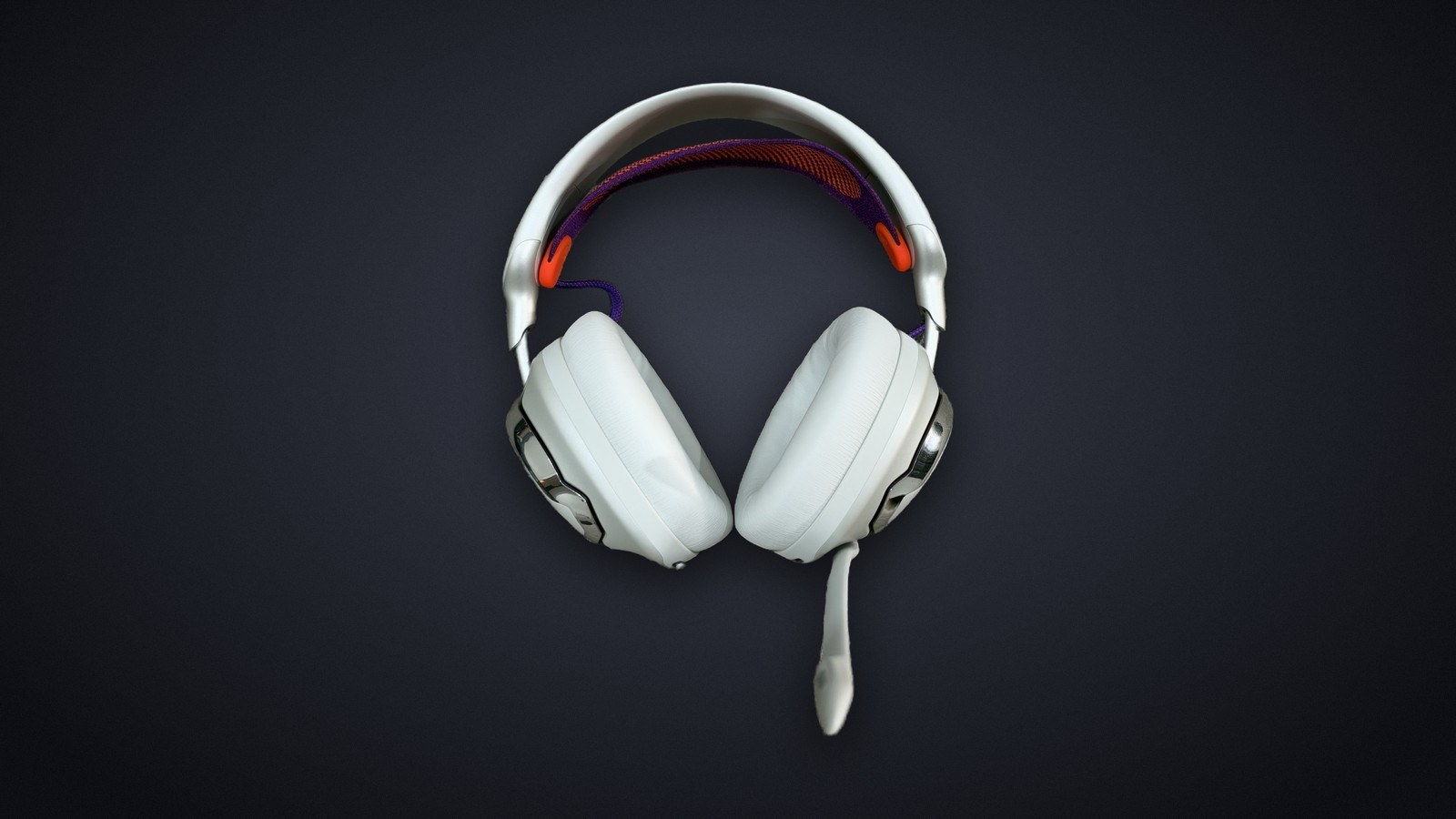
The JBL Quantum 950 is the best gaming headset we have tested, and it is the first piece of hardware to earn a 10/10 from INSERT FUTURE. It is a wireless headset built for playing at home. It connects to your console or computer and your phone at the same time, runs on two swappable batteries that take turns so you never have to stop and recharge, and has a boom mic that sounds very good by headset standards.
JBL is part of Harman, and it loaned us the white version with purple and orange accents for this review. Over a little more than a week, we played a bit of everything on a PS5, a Mac and a Windows PC, including Control Resonant and Clair Obscur: Expedition 33 on PS5 and Baldur's Gate 3 on PC, and we talked to other people through its mic. Our everyday headphones are a pair of Sony WH-1000XM3, noise-canceling cans built for music and commuting, and they are our point of comparison. We did not measure sound, latency or battery life with lab equipment, so battery and latency figures come from JBL, and anything we say about measured sound comes from other reviews.
In the US, the headset is sold as the Quantum 950X, which retailers such as Sweetwater list at $399.95. US stores also pitch the 950X for Xbox. We tested the European Quantum 950, and JBL does not list Xbox support for that model.
We found three drawbacks. It is heavy, it plays quietly on a computer until you change one setting, and the mic does not flip up. None of them cost it the top score.
Comfortable for hours, but you feel the 398 grams
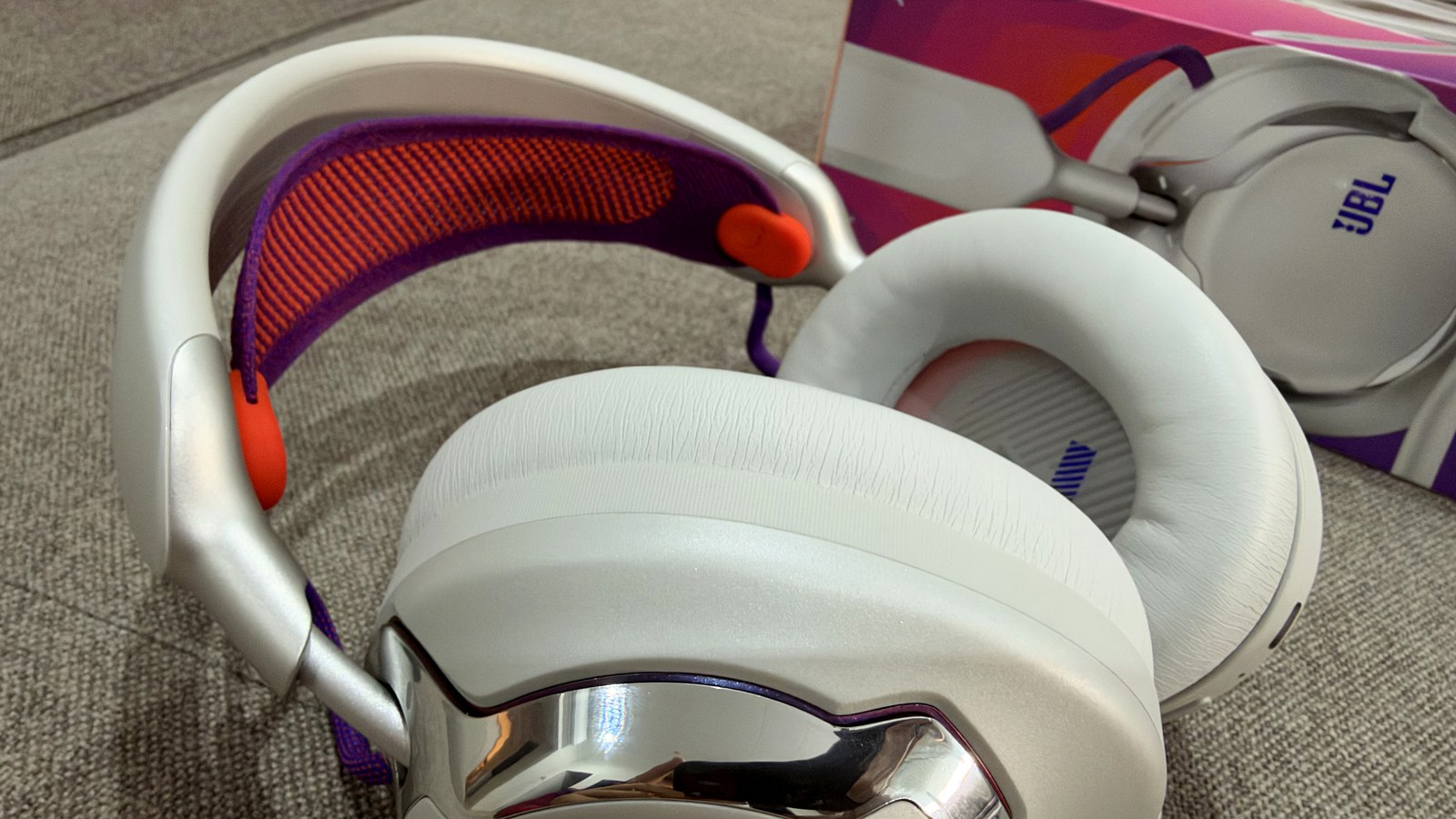
This is a big, eye-catching headset. Our white unit pairs white plastic with a metal arm, chrome trim on each ear cup and a purple and orange mesh strap under the headband. That strap works like a hammock, since it is the part that rests on your head and spreads the weight. The ear cushions are memory foam, which gives under pressure and slowly springs back, wrapped in leatherette. The cushions, mesh, mic and cables can all be replaced at home with parts JBL sells separately.
JBL puts the weight at 398 grams, about 14 ounces. Our Sony WH-1000XM3, which fold flat into their case for life on the go, weigh 255 grams according to Sony, so the JBL carries 143 grams more. It is 128 grams heavier than the 270-gram Razer BlackShark V3, the top overall pick in our gaming headset guide, and well below the 560-gram Audeze Maxwell 2 on the same list. The hammock and cushions do their job, yet after a few hours of straight play you start to feel the weight. That is the first of its three drawbacks.
Two batteries that take turns
The Quantum 950 ships with two 700 mAh batteries. That number tells you how much energy each one holds, not how long it lasts, because runtime depends on how you connect and whether noise canceling is on. Per battery, JBL quotes up to 25 hours over the base station's wireless link and 18 hours of talking over that link with noise canceling on, the most demanding case on its spec sheet.
While you use one battery, the other charges in a slot on the base. A full charge takes about three hours, according to JBL's spec sheet, so the spare is topped up long before the one in your headset runs dry, even in the 18-hour worst case. When it does, you pop the cover off the right ear cup and drop in the charged one. JBL adds the two together for 50 hours. In practice, you never have to stop mid-match to recharge or play tethered to a charging cable.
For us, a single charge lasted several days of use, and we never needed the spare.
PS5, Mac and PC through the base, plus your phone over Bluetooth
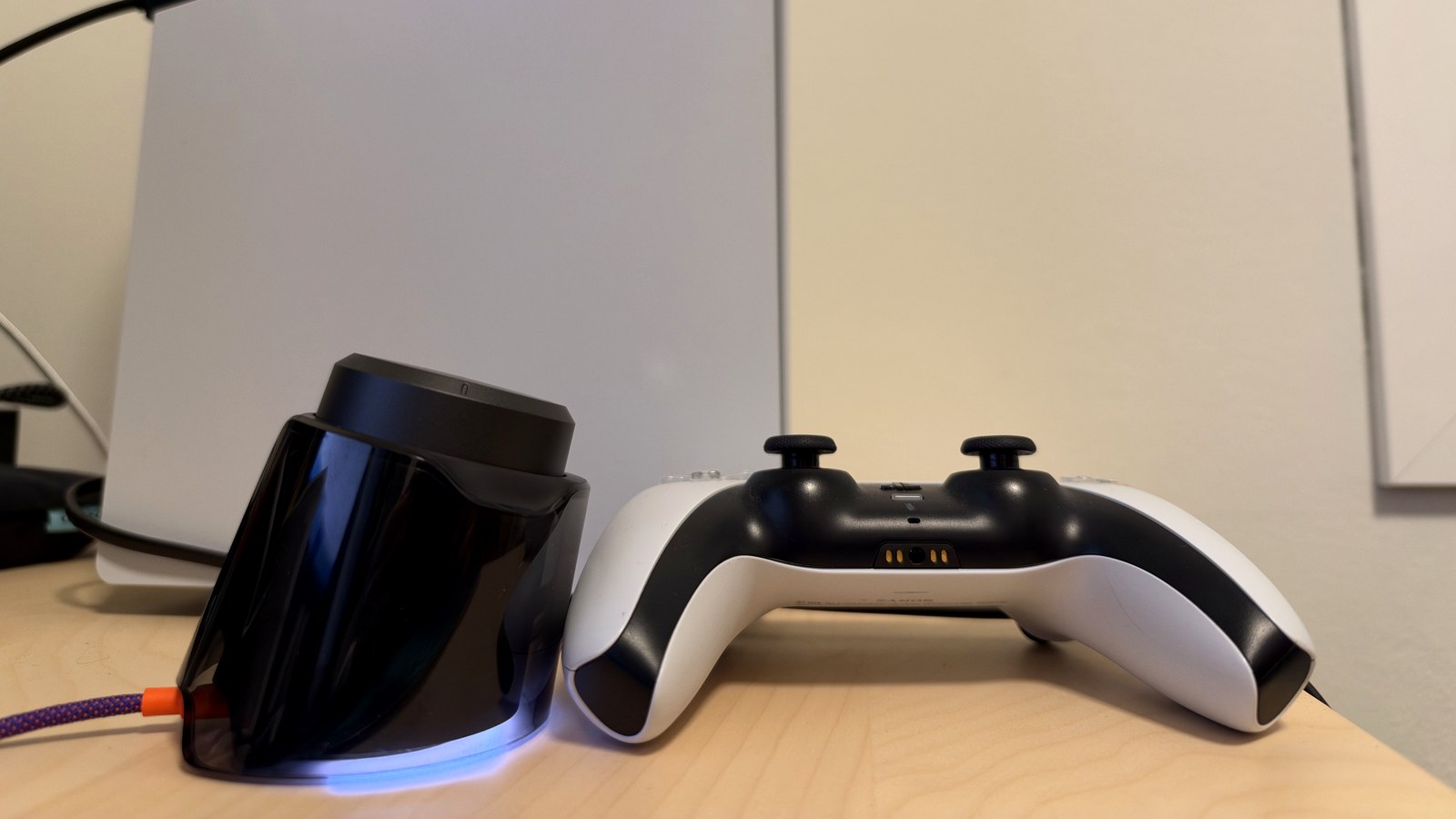
The 173-gram base station is mainly a wireless receiver. It plugs into a PC, Mac, PS5, PS4 or Switch over USB-C and pairs on its own with the headset over a dedicated 2.4 GHz wireless link, separate from Bluetooth, that JBL bills as low latency, meaning very little delay between what happens in the game and what you hear. That is how we used it on PS5, with the base plugged into the console's USB port.
The 2.4 GHz link runs alongside Bluetooth 5.3. You can play with the base plugged into your console or computer while your phone stays paired for music or calls, without taking the headset off.
On Windows and Mac, the headset shows up as two sound devices, "JBL Quantum 950 Wireless Game" and "JBL Quantum 950 Wireless Chat." The manual tells you to use Game for the game and Chat for talking.
This is where we hit the second drawback. With Game selected as the output, audio came through quietly on both the Mac and the PC, and we had to crank the volume all the way up. The fix is to pick Chat in the system's sound output menu, which brings the volume back to normal.
You can also go wired over USB-C or a 3.5 mm jack, which is how you get the high-resolution (Hi-Res) audio JBL advertises. Bluetooth compresses the signal, trimming data so it fits over the connection, as our guide to lossless audio over Bluetooth and USB-C explains.
An RGB base station and an app we loved
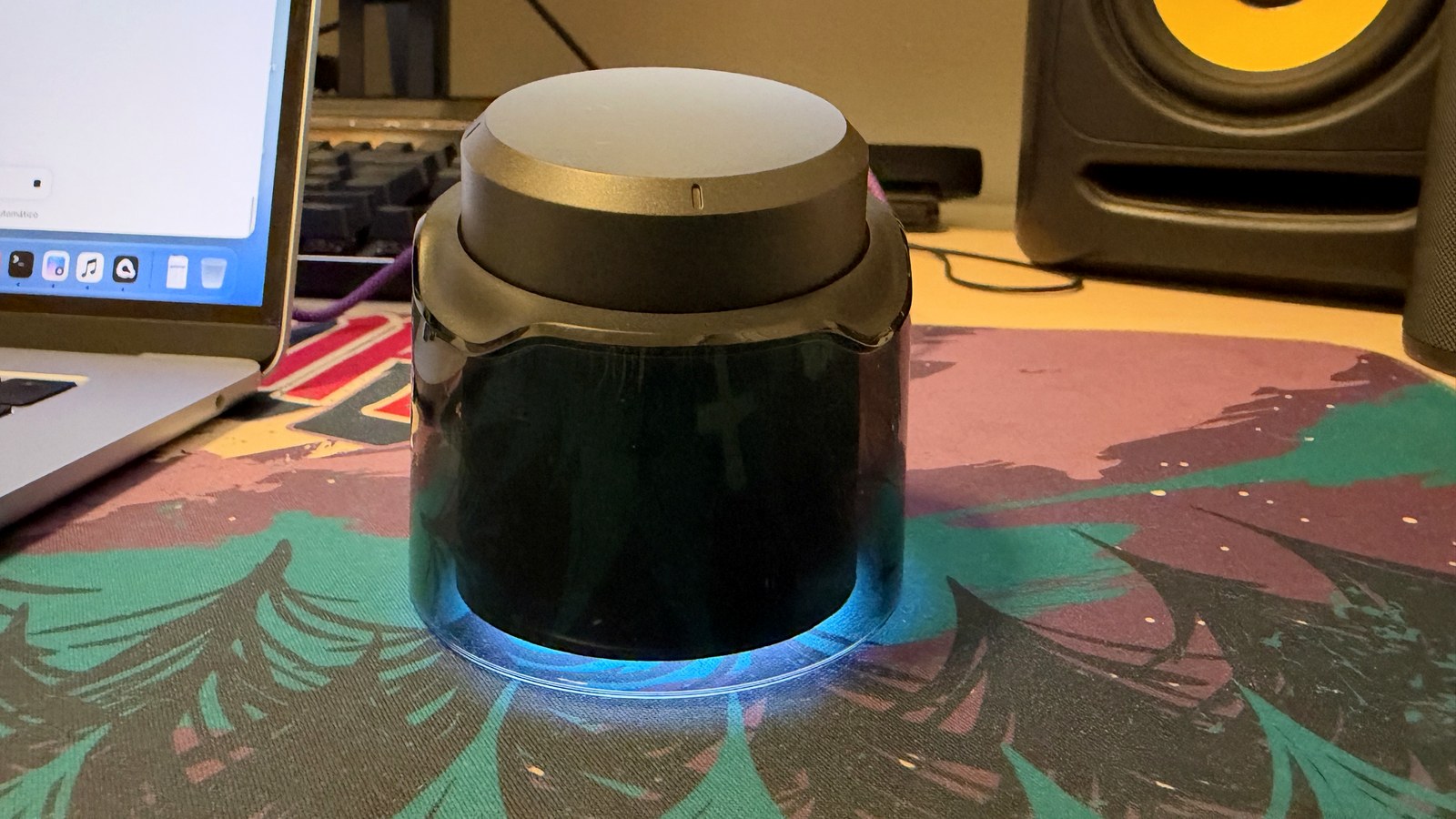
The base doubles as a desktop controller. Its wheel sets the volume, mutes the mic when pressed and shifts the mix between game and chat, while an RGB light ring changes color to show the connection, the mic status and the spare battery's charge.
Those controls are a nice extra if you have room on your desk, but you can live without them, since the headset has the same controls on its ear cups.
We loved JBL's QuantumENGINE app for customizing the base. It sets the light's colors and effects, adjusts the EQ, which raises or lowers bass, mids and treble, tunes the mic's noise reduction, turns on head tracking and updates the headset's firmware. We used it on both Windows and Mac.
Spatial sound, head tracking and noise canceling
Each ear cup holds a 50 mm driver with a carbon diaphragm, a material JBL uses to keep distortion down. Reviews that measured it agree that the bass and the mids, where voices live, come out balanced with low distortion, and one hears the bass pushed slightly forward. They split on the treble, with one measurement finding it flat and another a dip that takes a little clarity off the top. We are not audio engineers, but to our ears Control Resonant, Clair Obscur: Expedition 33 and Baldur's Gate 3 all sounded great.
Spatial sound processes game audio so it seems to come from different points around you instead of just left and right. Head tracking notices when you turn your head and keeps each sound anchored in place, the way a real noise in the room would stay put. A calibration mic in the box tunes the effect to your ears. Consoles get the QuantumSPATIAL 360 version, and two other options are Windows-only.
We tried it with videos and it didn't win us over. We haven't used it in games, where other testers describe it as precise at placing footsteps behind you or off to the side, with head tracking that reacts instantly when you turn. Our advice is to try it in shooters, where knowing where a footstep came from helps you react sooner, and switch it off for movies and shows if it doesn't work for you. A button on the ear cup turns it on and off.
Noise canceling, which plays an opposite signal to cancel outside sound, blocks out the room very well, and another button switches to Ambient Aware mode so you can hear someone talking to you. Sound does leak the other way at high volume, so someone next to you in a quiet room may hear your game.
A very good mic for a headset
The 6 mm boom mic is cardioid, so it mostly picks up what is directly in front of it, your mouth, and much less from the sides and back. QuantumENGINE lets you adjust its noise reduction, which JBL says also filters out keyboard clatter. We found it pretty good for a headset mic. Our Sony WH-1000XM3 pick up your voice with mics built into the ear cups, while this boom sits right by your mouth.
The third drawback is that it neither flips up nor tucks into the ear cup. If you want it out of your face to listen to music or watch a movie, you have to unplug it from the left ear cup and store it separately. JBL lists no other mic on the headset, so with the boom removed you have nothing to talk into.
Why it gets a 10
A 10 from us does not mean the Quantum 950 is flawless. It means it is the benchmark for its category, the one we would recommend without hesitation to anyone after a high-end wireless headset for gaming at home across several platforms. Two batteries that take turns, a base station that runs alongside your phone's Bluetooth and a very good mic for a headset put it there. Until now, no hardware had scored above 9 at INSERT FUTURE, and the other gaming headset we've reviewed, the MSI Maestro 500 Wireless, landed at 8, with weight after a couple of hours among its drawbacks too.
Its three drawbacks do not change that recommendation. The detachable mic only gets in the way when you are not gaming or chatting. The weight you notice after a few hours buys you two swappable batteries, memory foam cushions, a mesh headband and a metal arm. And the quiet Game output goes away once you pick Chat in your computer's sound settings. Two smaller issues don't change it either. Spatial sound didn't win us over with videos, and at high volume someone next to you can hear some of your game.
We recommend it to anyone who games at home on PS5, PC or Mac, wants to chat with friends while keeping their phone connected, and never wants to stop mid-match to recharge. It is not for anyone who wants a light headset for the street. Xbox players should know that our score covers the European Quantum 950, which JBL does not list for Xbox, and not the Xbox compatibility that US retailers advertise for the 950X, which we haven't tested. At $399.95 list it is expensive, and for everything it does we think the price is justified.
Frequently asked questions
Does the JBL Quantum 950 work with PS5?
Yes. The base station plugs into a PS5 over USB-C and pairs with the headset over 2.4 GHz, and JBL QuantumSPATIAL 360 spatial sound works on the console. You can also connect by USB-C cable. We gamed with it on PS5, and it can stay paired to your phone over Bluetooth at the same time so you can take calls.
Does the JBL Quantum 950 work with Xbox?
JBL does not list Xbox for the Quantum 950 we tested. Its manual covers PC, Mac, PlayStation and Switch for the base station's wireless link. In the US, the headset sells as the Quantum 950X, which retailers market for Xbox as well. We have not tested that version, so check the box before buying for an Xbox.
How long does the JBL Quantum 950 battery last?
JBL quotes up to 25 hours per battery over the base station's wireless link, 30 hours on Bluetooth alone with noise canceling off, and 18 hours of talk time with it on. You get two 700 mAh batteries, and the spare charges in the base in about three hours, so one is always ready. We did not time it, but one charge lasted us several days of use without touching the spare.
Can you remove the mic on the JBL Quantum 950?
Yes. The 6 mm cardioid boom mic plugs into the left ear cup and detaches, and removing it is the only way to get it out of the way, since it does not flip up or retract. JBL lists no other mic on the headset, so you cannot talk without the boom. We found it pretty good for a headset mic.
How much does the JBL Quantum 950 weigh?
JBL lists the headset at 398 grams, about 14 ounces, and the base station at 173 grams. That is heavier than the 270-gram Razer BlackShark V3 but lighter than the 560-gram Audeze Maxwell 2. The mesh headband and memory foam cushions spread the load well, though you feel it after a few hours of play.
Is the JBL Quantum 950 worth it?
We think so. It earns a 10/10 as the best gaming headset we have tested for playing at home on PS5, PC or Mac, with two swappable batteries, a base station that works alongside Bluetooth and a good mic. US retailers list it as the Quantum 950X for $399.95. Skip it if you want a lightweight headset for the street.
The conversation starts here
Sign in with a supporter account to comment. Sign in

Nobody has commented yet. Want to go first?