
When GPT-6 Astra reaches ChatGPT Plus and Pro
OpenAI has introduced GPT-6 Astra and begun a limited rollout to organizations in its Trusted Access and Daybreak Access programs. The company says the model will become available over the coming days across ChatGPT Plus, Pro, Business and Enterprise, as well as the API and Amazon Web Services. It has not assigned an exact date or time to individual accounts.
Plus subscribers will receive the standard GPT-6 Astra model. Pro, Business and Enterprise users will also get GPT-6 Astra Pro, which spends more compute on difficult problems. OpenAI says both models fit within the existing allowances for each subscription, with credits available for additional use. Enterprise workspaces will have Astra disabled by default at launch until an administrator enables it.
Free and Go are not included in the availability list, and OpenAI has announced no change to the price of Plus or Pro. Until the rollout is complete, the model picker on each account is the most reliable indication that access has arrived.
What changes from GPT-5.6 Sol
Astra and Sol share the same maximum 1,050,000-token context window, the text and other data available within a request, with up to 128,000 tokens generated in a response. That is not permanent memory across chats. The official model card advances the knowledge cutoff from February 16 to April 30, 2026. Our GPT-5.6 Sol analysis covers its predecessor.
API pricing rises to $10 per million input tokens and $50 per million output tokens, up from $4 and $20 for GPT-5.6 Sol. Cached input moves from $0.40 to $1. That makes Astra exactly 2.5 times more expensive per token, with another multiplier applied when a prompt exceeds 272,000 tokens. These are developer rates. They do not signal a change to ChatGPT subscription pricing.
OpenAI reports gains in work involving tools. On OSWorld 2.0, which tests completing tasks on a computer, Astra scores 72.6% against Sol's 65.7%. On ScreenSpot-Pro, identifying interface elements, it reaches 92.7% versus 76.9%. Terminal-Bench 4.0, built around tasks in a terminal, rises from 37.3% to 57.9%. These are OpenAI's results in those environments, not guaranteed success rates for arbitrary jobs.
ARC Prize found a striking dependence on the execution environment. Astra scored 62.7% with the standard harness and 99.9% with an OpenAI-provided adapter that preserves the model's opaque reasoning and context compaction. Quoting the 99.9% result alone would leave out a major part of the test setup.
Astra is built for longer work with tools
The main architectural changes matter after a model starts acting. Astra can make asynchronous tool calls, accept new instructions midway through a task and change reasoning effort without invalidating its cache. OpenAI also says it holds on to the objective more reliably as a job runs longer or an application changes underneath the agent.
Developers can connect the model to search, files, images, code execution and external applications. That describes integration options, not a guarantee that every tool will appear in each subscriber's ChatGPT interface. The API also removes the `none` reasoning option, with effort running from `low` through `max`.
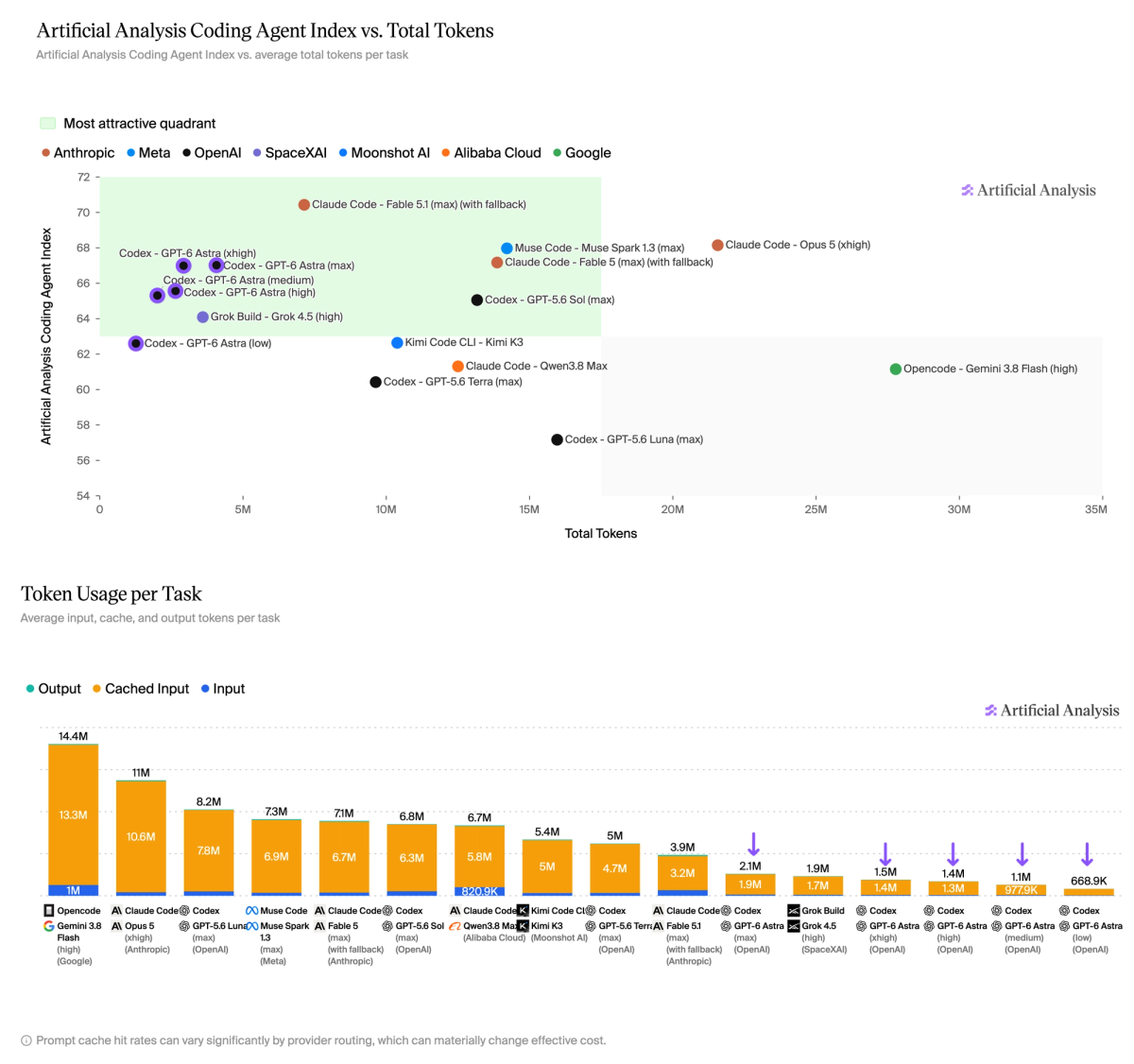
OpenAI reports that Astra completed OSWorld tasks 47% faster and ran Mind2Web 1.9 times faster in its coding environment than the current Sol experience. Artificial Analysis' independent evaluation points in the same direction: Astra reached 67 on its Coding Agent Index while using roughly 70% fewer tokens than Sol at maximum effort. On those coding workloads, the efficiency was enough to offset the higher token price.
Independent testing finds a smaller gain outside agentic work
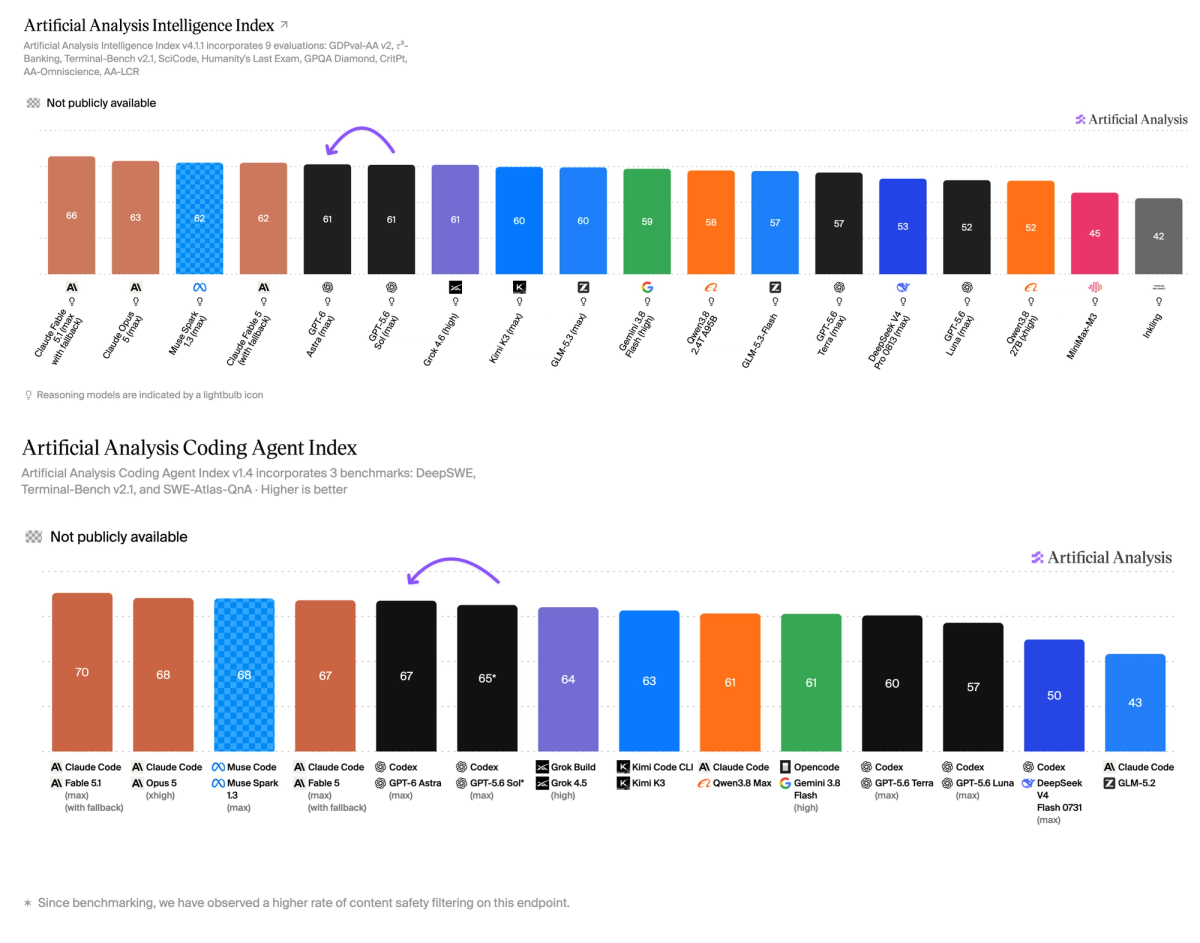
Artificial Analysis gives Astra 61 on its Intelligence Index, tied with GPT-5.6 Sol and five points behind Claude Fable 5.1. It also recorded two-to-three-point regressions on some banking, scientific coding and long-context reasoning tests. Across that broader suite, Astra produced around 10% fewer tokens but cost about 75% more per task than Sol.
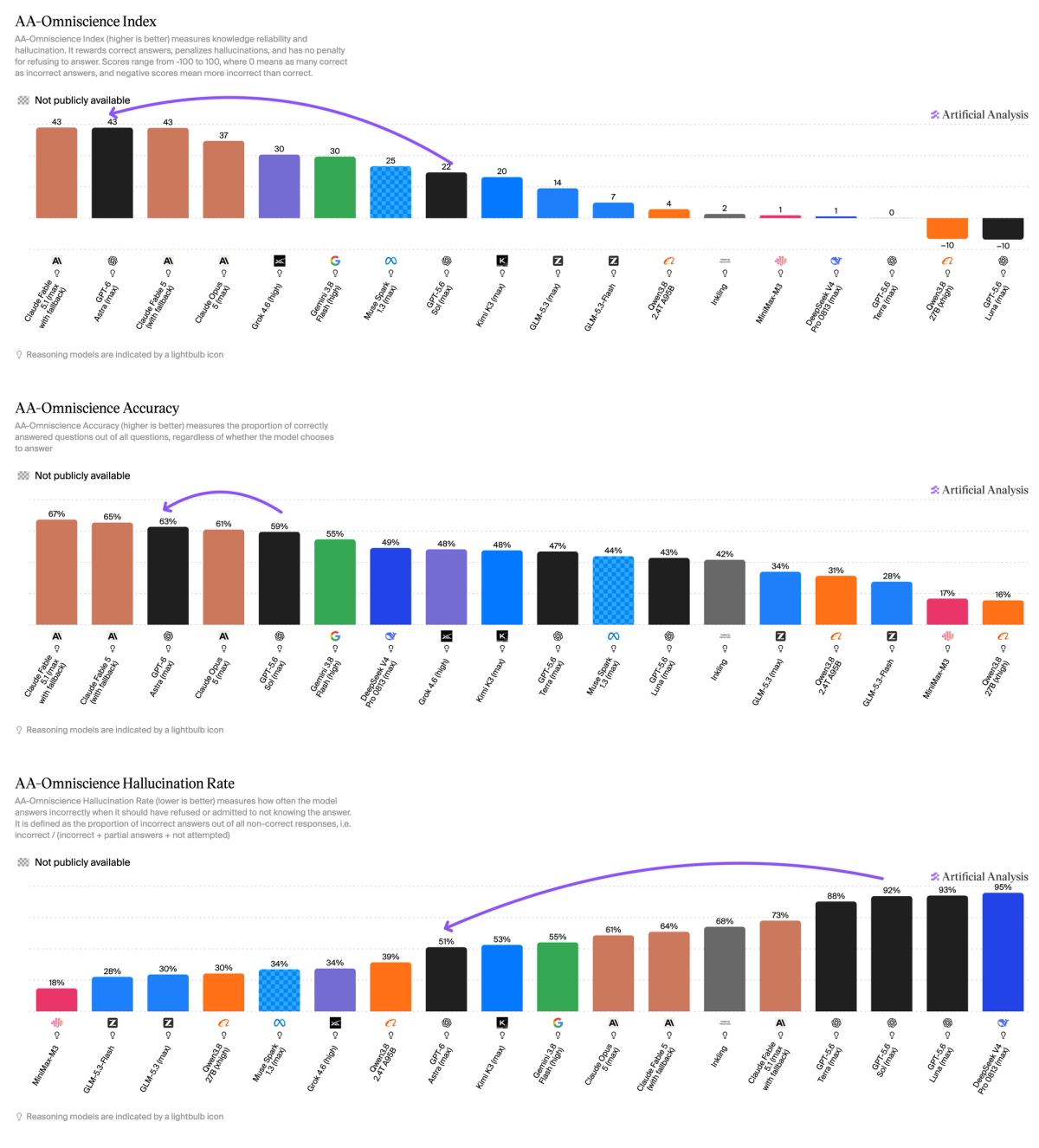
Reliability improved more clearly. On AA-Omniscience, the hallucination rate dropped from 92% for Sol to 51% for Astra while accuracy rose by four points. The absolute rate is high because the benchmark deliberately asks very difficult questions and tests whether models admit what they do not know. Within that setup, Astra still fabricated substantially fewer answers.
Safety will limit some of the model's reach. Astra is the first OpenAI system to cross the company's Critical cybersecurity threshold after finding two previously unknown vulnerabilities and completing lab attacks that Sol could not. OpenAI will gate the strongest cyber functions and monitor deployment for signs of misalignment. It also acknowledges that Astra's written reasoning is harder to monitor than Sol's, which matters when an agent works unattended for long periods. Our Astra cybersecurity analysis covers those tests and restrictions in detail.
The available evidence does not suggest that every short chat will feel as different as the agent benchmarks imply. Astra looks most consequential for coding, research, operating applications and coordinating several tools. Plus provides the standard model, while Pro adds Astra Pro for work that benefits from more compute. A definitive comparison will have to wait until both variants are broadly available in ChatGPT and their usage limits are known.
The conversation starts here
Sign in with a supporter account to comment. Sign in


Nobody has commented yet. Want to go first?