
Mistral has released the weights for Mistral Large 4, its largest AI model, and anyone can download them from Hugging Face without signing up or asking for access. The weights, also called parameters, are the numbers the model tuned during training, and they hold what it learned. Having them means you can run it on your own machines instead of Mistral's servers. The Paris-based company published them on October 29, three weeks after opening an API preview.
The license lets you use, modify and sell the model for free, including inside a business. The one exception covers anyone offering it to others as a hosted service, who first needs a commercial agreement with Mistral. The real barrier for most people is size: the full version weighs 1.06 terabytes. If you want the basics on what "open weights" means and what it leaves out, start with our open-weights explainer.
A trillion parameters, with about 49 billion at work at once
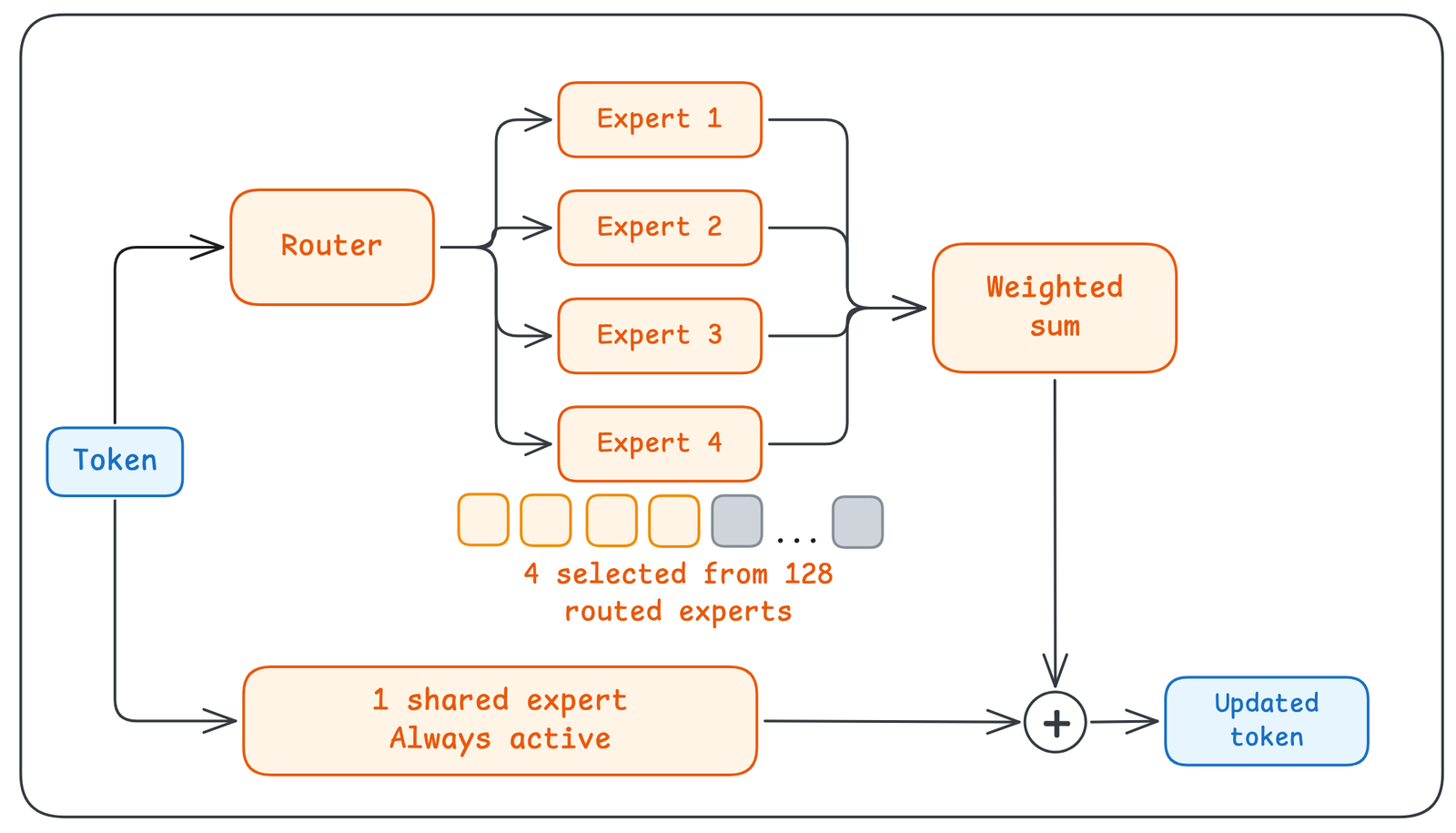
Large 4 has roughly 1.05 trillion parameters, but it doesn't use all of them for every word. It's what's known as a mixture-of-experts model. The model processes text in layers, stages of calculation stacked one after another, and Hugging Face's breakdown shows that nearly every layer holds 128 specialized blocks, the so-called experts. For each token (the chunk of text the model works with), a router picks four of those blocks, plus a fifth shared block that always runs. The model card puts the active count at about 49 billion parameters per token, or 52 billion including the input and output layers.
That design cuts the amount of calculation, since each token costs roughly what it would on a 50-billion-parameter model. It doesn't cut memory. The router may need any block for the next token, so the whole trillion has to stay loaded in memory.
The model takes text and images and replies in text. Its context window, meaning how much material it can consider in a single request, reaches one million tokens, although Hugging Face's sample configurations cap it at 131,072. Mistral offers three reasoning levels, which set how much the model works through a problem before answering (low, medium and high, with high as the default), and says the model handles more than 160 languages.
The hardware it takes
There are two official versions. The main one stores each parameter in a single byte, so its roughly 1.05 trillion parameters come to 1.06TB across 54 files. Hugging Face deploys it on a server with eight NVIDIA H200s, data center graphics cards (GPUs) that do the model's math. Together they provide a little over 1.1TB of memory, just enough to hold the whole model.
The second, called NVFP4, keeps most parameters at 4 bits, half a byte, and shrinks to about 610GB. It's built for NVIDIA's Blackwell generation, such as the B200 or B300, which have circuitry dedicated to that format. Dell, for example, offers it on a server with four B300 cards.
The closest an individual can get is the compressed GGUF builds from the llama.cpp team and Unsloth. If the file formats are new to you, our GGUF vs. safetensors guide covers them. The smallest build is 233GB, and Unsloth recommends 384GB to 512GB of memory for the 2-bit versions. Hugging Face ran the llama.cpp 2-bit build on a Mac Studio with an M3 Ultra and 512GB of unified memory, which the processor and graphics share, and measured about 15 tokens per second. Squeezing a model that hard usually costs accuracy, and neither Mistral nor Hugging Face has published how much this one loses.
That puts it in the same league as Meta's Muse Spark Open, which also needed a 512GB Mac for its most compressed version. It won't fit on a laptop or a typical gaming PC.
Using it without the hardware, and what it costs
If you don't have that kind of machine, you can use the model over the internet. Mistral serves it through its API and Mistral Studio, and it's also available on OpenRouter, NVIDIA's hosted endpoints and Microsoft Foundry.
Mistral's documentation lists API pricing at $0.70 per million tokens the model reads, $0.07 if that input was sent before and is still cached, and $2.10 per million tokens it writes. We break down how per-million-token pricing turns into an actual bill in our AI API explainer.
For self-hosting, Mistral and Hugging Face provide instructions for vLLM and SGLang, two programs that serve the model to other applications, along with ready-made containers. Hugging Face also shows how to fine-tune it on your own examples, though its recipe uses a server with eight B300 GPUs.
What Mistral claims about performance
The performance numbers come from Mistral, which pitches Large 4 as strong at coding, at agents (systems that carry out multistep tasks on their own rather than just answering) and at cybersecurity. It reports a 48% score on Artificial Analysis's coding agent index, tied with GLM-5.3 while using 47% fewer tokens per task. In a blind code comparison judged by people, Mistral says only Claude Opus 5.5 ranked higher among the models tested. It also says the model refused 96.6% of the malicious cyberattack requests in its tests, the highest rate it has measured for an open model.
The technical report that would show how those tests were run hasn't been published yet. Mistral does say it trained the model from scratch in its own European data centers, on 3,800 NVIDIA Grace Blackwell chips according to the model card. With downloadable weights, a company or government agency can run a top-tier model on its own servers without sending documents to another provider, as long as it buys or rents the machines described above.
The conversation starts here
Sign in with a supporter account to comment. Sign in

Nobody has commented yet. Want to go first?