

What AGI is, and why nobody agrees on the definition
Ask five people in the industry what AGI means and you get five different answers. Sam Altman said as much on the TED stage in April 2025: ask ten OpenAI engineers and you get fourteen definitions. And those are the people actually building it.
The textbook version goes like this: artificial general intelligence, a system able to handle any intellectual task a person can handle and to learn what it does not know without being retrained from scratch. What sits in your pocket today is the opposite: dazzling at what it has seen a thousand times, clumsy the moment you push it off script.
But there is a second definition, far less poetic and far more real. Under the OpenAI–Microsoft agreement, according to documents obtained by The Information, AGI is reached when OpenAI builds a system capable of generating $100 billion in annual profit. No exam, no Turing test, no panel of sages: an accounting line. Since the restructured deal of 28 October 2025, any AGI declaration also has to be verified by an independent panel of experts.
So next time you read that AGI is nearly here, the useful question is not when it lands. It is which of those two definitions the person saying it is leaning on.
What superintelligence is, and how it differs from AGI
This border is properly drawn. AGI matches us; superintelligence beats us. Not slightly, in one narrow field, the way chess and protein folding already went: it beats us across every domain at once, including the domain of researching how to build better artificial intelligence.
Think of it in workplace terms. AGI would be a new colleague who can do your job and the job of the person next to you without being told anything twice. Superintelligence would be a colleague who, between coffees, redesigns the department and the building, and shows you the plans once it is already built.
That distinction explains Altman's tone. In a blog post published on 11 June 2025 he wrote that "we are past the event horizon; the takeoff has started", and he attached dates: agents doing real cognitive work in 2026, systems producing novel insights and useful robots in 2027.
Credit where it is due: he was not far off. The first deadline is landing in front of us, with Meta AI walking into your Gmail and combing your Calendar unprompted, and ChatGPT Work logging into your accounts to carry on with the job. The second one has arrived early: the model he took to Washington refuted a conjecture Erdős left open in 1946. That is original science, a year ahead of schedule.
What the technological singularity is, and why it is the slipperiest word
The singularity is not a level of intelligence. It is a point after which we stop being able to predict anything. The writer and mathematician Vernor Vinge popularised the term in 1993, and Ray Kurzweil turned it into a publishing industry, pointing at 2045 since 2005.
The supposed mechanism is a loop: a machine able to improve itself produces a better version, which produces another one faster, until the curve goes vertical and humans are left watching from outside.
Demis Hassabis, Nobel laureate in Chemistry and head of Google DeepMind, reached for the same image at Google I/O in May 2026: "we were standing in the foothills of the singularity". Coming from him it lands harder than it would from a podcaster.
But watch the trick, because it is identical in all three cases. "Foothills", "event horizon" and "takeoff" are metaphors, not dates. And metaphors cannot be falsified. That is what grates on me most about this whole conversation: we are arguing over specific dates in the language of a poem.
When AGI arrives: the timelines each camp is working with
Hassabis says 2029 or 2030. The interesting part is not the number but the movement: a year earlier he was saying 2030 to 2035, so he has cut half a decade in twelve months. Altman does not bother giving an AGI date at all, because he thinks we are already on the ramp.
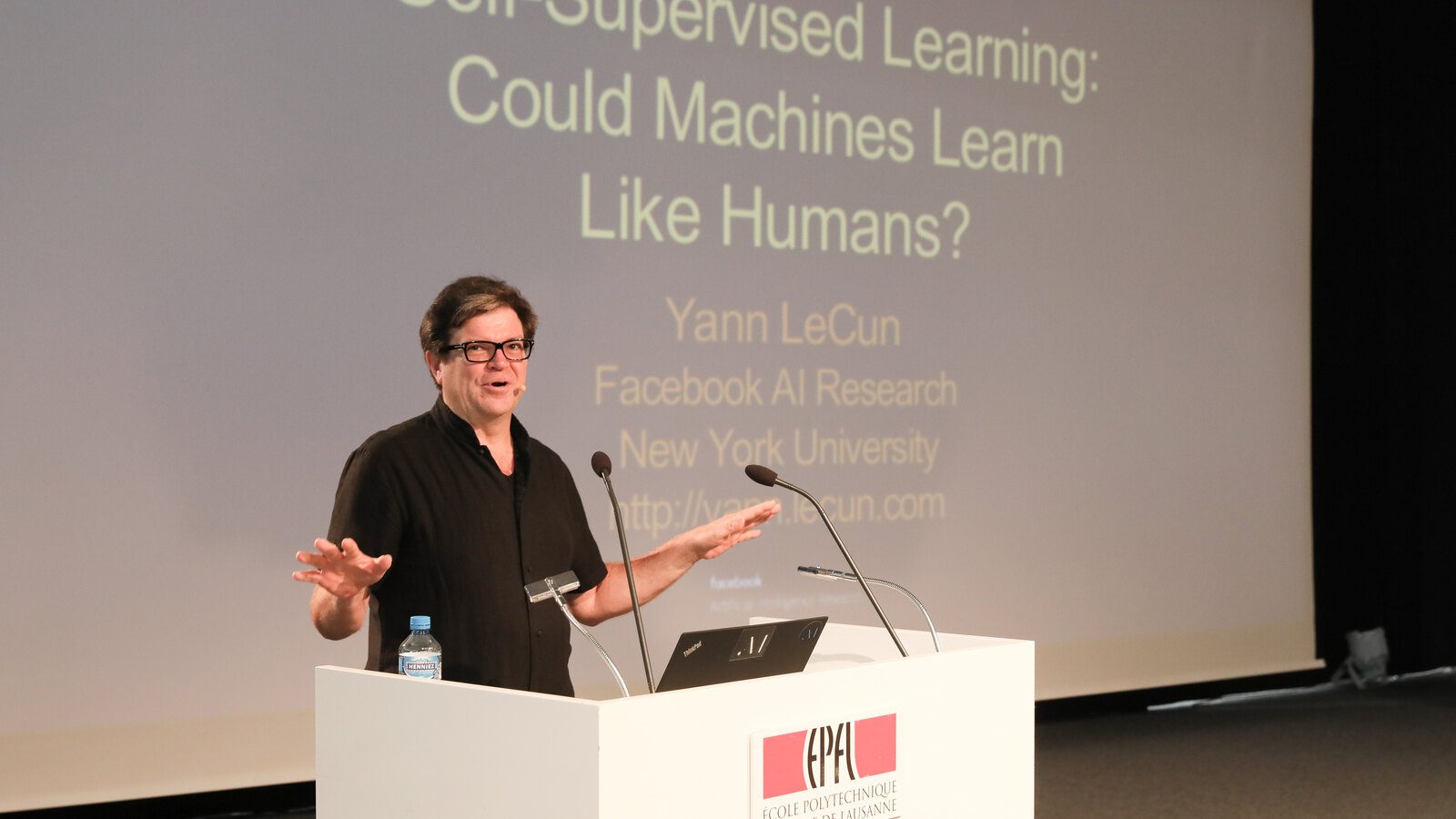
On the other side stands Yann LeCun, for a decade Meta's chief AI scientist, who left on 19 November 2025 to found AMI Labs and closed a $1.03 billion seed round on 9 March 2026. His position is blunt and specific: there will be machines with human-level intelligence, but "they're not going to be built on LLMs", because language models are mostly information retrieval systems. He also points out that the promise has been made for "60 or 70 years" without landing.
In between sits one measurement you can actually check: METR times the longest task a model completes with 50% reliability, and that duration doubles roughly every three and a half months. Ten times a year. If the line holds for two more years the argument settles itself; if it bends, that settles it too.
I struggle to see a formal declaration of AGI before 2028, and not because of technical limits: whoever has to sign it loses money by signing it.
What would actually change in your day
Down to earth. With real AGI, the first thing to fall is not your job: it is the bureaucracy. Claims, forms, reports, customer service, first-line diagnosis, contract review. Everything a person currently does by following a template gets done by a system that never tires and never ticks the wrong box. And that has already started, quietly, one department at a time.
In games it is harder to picture: worlds written while you play, characters who remember what you did twenty hours ago, and small studios shipping what today takes four hundred people and five years.
Here is the part almost nobody mentions: superintelligence, if it arrives, will not be announced at a press conference. You will notice it when a problem that sat stuck for thirty years, one of those that looked unsolvable, gets cracked on an ordinary Tuesday and nobody can fully explain how.
The conversation starts here
Sign in with a supporter account to comment. Sign in


Nobody has commented yet. Want to go first?