

A cloud agent from one API call
OpenAI has released Agents API in public beta, giving developers the same managed harness behind Codex. One request specifies a task, model, tools and environment. The service keeps the session, streams progress and coordinates long-running work.
The official announcement targets jobs lasting hours or days. This is more than a longer answer: an agent can work with files, run code, save intermediate results, recover and continue across multiple context windows.
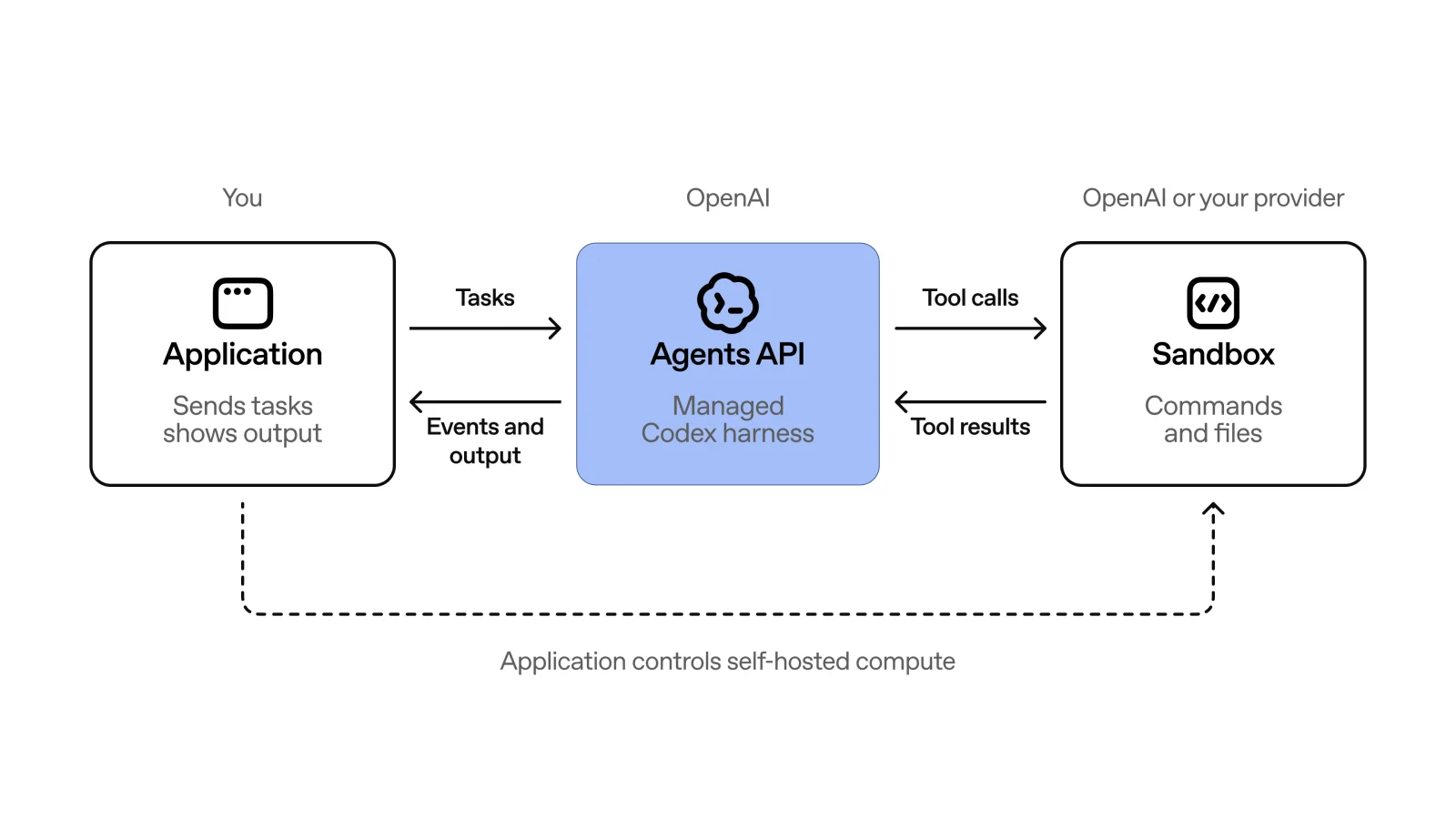
The harness and computer are separate
OpenAI hosts the logic coordinating the model, context and tools, while developers choose execution. Work can run in an OpenAI-managed sandbox, on their own infrastructure, or with providers including Cloudflare, Daytona, E2B, Modal, Oracle, Runloop and Vercel.
That separation lets teams place data in an appropriate environment and choose CPU, GPU, memory or storage. OpenAI's sandbox supports files, packages, skills and plugins. It productizes the architecture in our guide to how AI agents work.
Context, MCP and subagents
Agents API compacts context near a session limit, loads tool definitions only when needed and supports programmatic calls that run operations in parallel or filter results before returning them to the model. It works with MCP, custom functions and built-in tools such as web search.
A main agent can also delegate independent work to subagents with separate contexts. That can reduce interference, but it does not guarantee correctness. Evaluations, permission boundaries and human review still belong to the product team.
Availability and price
The beta is available to all developers. OpenAI charges no separate Agents API fee. Customers pay for model tokens and tools. Long sessions, several subagents and powerful compute can still make a run expensive even without an access surcharge.
It arrives alongside GPT-6 Astra, whose agent focus and benchmark claims we examined. Production teams should set budgets, time limits, tool permissions and reproducible tests. Teams should also record which action each agent took and the evidence it used, because longer sessions expand both usefulness and the surface for mistakes. Managed orchestration removes infrastructure work, not product responsibility.
The conversation starts here
Sign in with a supporter account to comment. Sign in

Nobody has commented yet. Want to go first?