
You leave an appointment carrying a lab report, two words you cannot remember and a question that occurs to you after the doctor has already closed the door. At home, you search for the result, check how many hours you slept and try to remember whether the same number was high last year. You do not lack information. You lack someone able to see it together.
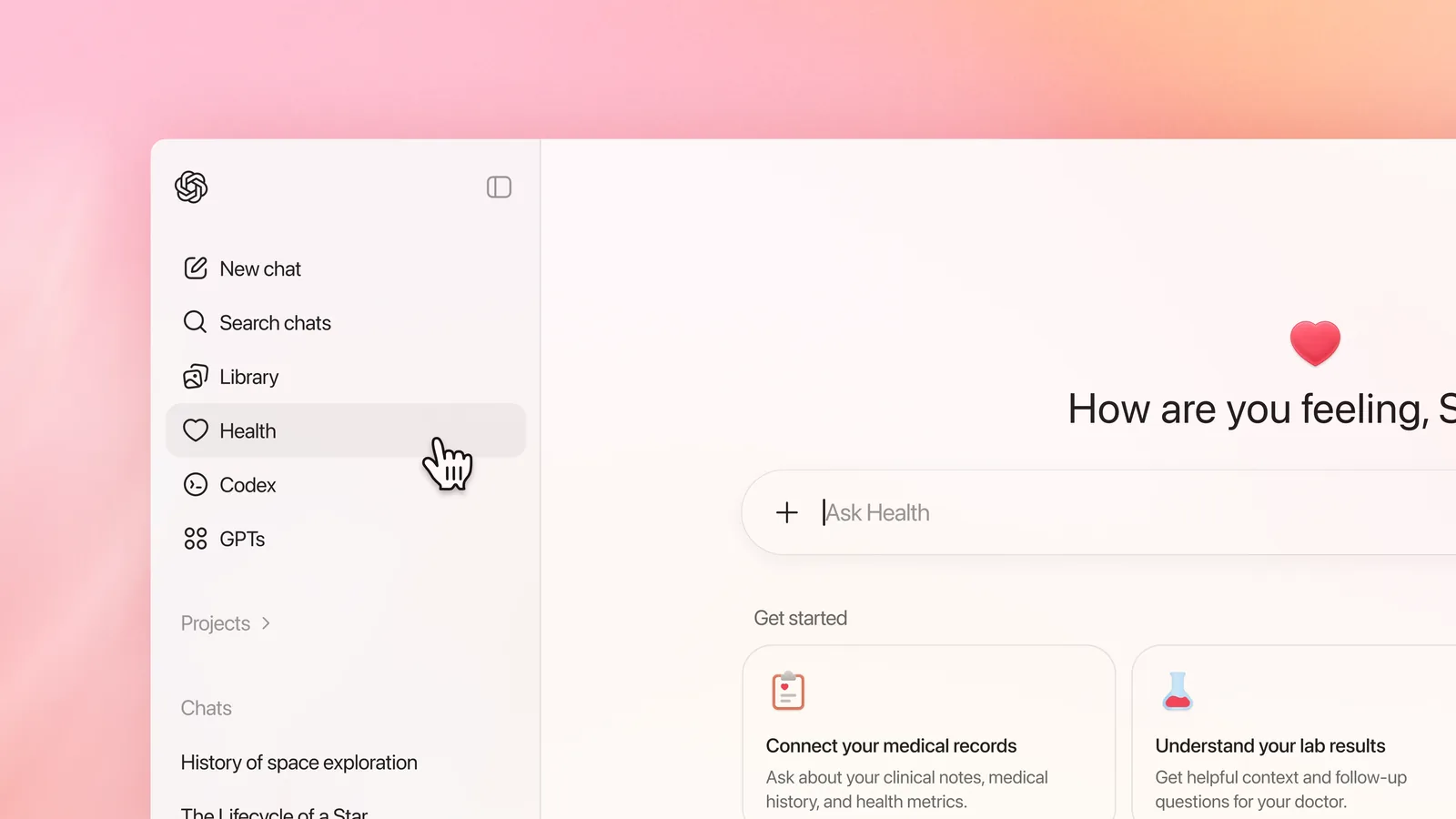
That is the problem ChatGPT Health is trying to solve. It does not want to stop at answering a medical question. It wants to arrive with your history already in view. It can connect Apple Health, supported provider portals, One Medical and Function Health to compare results, explain changes and help you prepare for the next appointment.
The feature sounds like a small improvement until you understand its real reach. The product is not one isolated answer, but the continuity between one question and the next.
The real change is no longer starting from scratch
ChatGPT was already an improvised health desk for millions of people. OpenAI says more than 300 million users ask it health-related questions every week. Health changes the raw material: instead of relying only on what you type in that moment, it can read the sources you choose to connect and follow a story over time.
That makes useful scenarios easy to picture. Give it two lab reports six months apart and ask what changed. Before an appointment, have it organise the questions you do not want to forget. Afterwards, turn the doctor's instructions into a list you can understand.
It is not a digital twin of your body and does not simulate how you will respond to treatment. It does something simpler: gathers, translates and remembers. That is exactly why it could reach far more people, far sooner.
OpenAI also found that more than 70% of health conversations happened outside the Health space. An allergy matters when choosing a restaurant; an injury matters when planning a run. ChatGPT can ask to use that context once or always, and you can summon it explicitly with @Health. The convenience is having the right fact appear at the right moment. The risk is forgetting you allowed it to keep appearing.
It can explain a lab report, but it should not decide for you
I see three possible jobs for Health. As a translator, it can explain a report written for another doctor. As an archivist, it can spot a trend buried across documents. The trouble begins when it starts replacing clinical judgement.
OpenAI says it worked with more than 260 physicians across 60 countries, 26 specialties and 49 languages, with those experts reviewing more than 700,000 responses. Its new HealthBench Professional uses difficult clinical tasks rather than simple multiple-choice questions. Those are signs of serious evaluation, but they remain tests designed or coordinated by OpenAI, not a promise of safety in every real conversation.
An independent study in npj Digital Medicine tested several chatbots on 222 patient questions and found potentially unsafe answers from all of them. GPT-4o reached 13% in that test. Health uses newer models and purpose-built safeguards, so the figure cannot directly judge the current product. It does preserve the essential warning: sounding calm and organised is not the same as being right.
ChatGPT can help you understand what to ask. It should not tell you to stop medication, confirm a diagnosis or delay urgent care on its own. OpenAI says the same in its help pages: Health is not intended to diagnose or treat disease, and it can make mistakes.
‘Not used to train models’ does not mean nobody can access your data
OpenAI says connected records and Health conversations will not be used to train its general-purpose models or target advertising. That is a meaningful protection, but it does not tell the whole story of what can happen to the information.
The Health Privacy Notice says a limited number of authorised staff and trusted service providers may access health data to improve model safety unless the user opts out. That is very different from feeding your record into mass model training. It is also very different from promising that no human being will ever see it.
Disconnecting Apple Health or a provider portal begins deletion of synced data, which can take up to 30 days. But if some of that information already appeared in a conversation, the chat stays until you delete that too. Memory cannot create facts directly from connected records, yet it may retain something you said during a health conversation.
In other words, unplugging the cable does not necessarily erase what already travelled through it. Before connecting an entire record, check the permissions, keep the ask-every-time setting and use Temporary Chat for anything you do not want retained.
When it reaches Europe, I would start with the smallest permission
ChatGPT Health is available to adults in the United States on the web and iPhone across Free, Go, Plus and Pro plans. It has no release date in Europe yet. Nor can it write new information into Apple Health or a hospital record: it can read those sources, but not alter them.
When it reaches Europe, I would not connect my entire medical life on day one. I would start with one source and one specific task: compare two lab reports, prepare an appointment or translate a note. I would verify medication names, doses and dates against the original document. Only then would I decide whether continuity is worth permanent access.
That limit does not make Health less valuable. It focuses the feature on what ChatGPT can genuinely do well: turn scattered information into better questions. We have already explained how ChatGPT works under the hood; it does not understand a body the way a doctor does, however convincing the answer sounds. But it can help you walk into the room knowing what you need to understand.
Health will not matter because it knows all of medicine. It will matter if it helps you know your own story without letting you forget who should make the final decision.
The conversation starts here
Sign in with a supporter account to comment. Sign in

Nobody has commented yet. Want to go first?