
A fresh forecast every hour
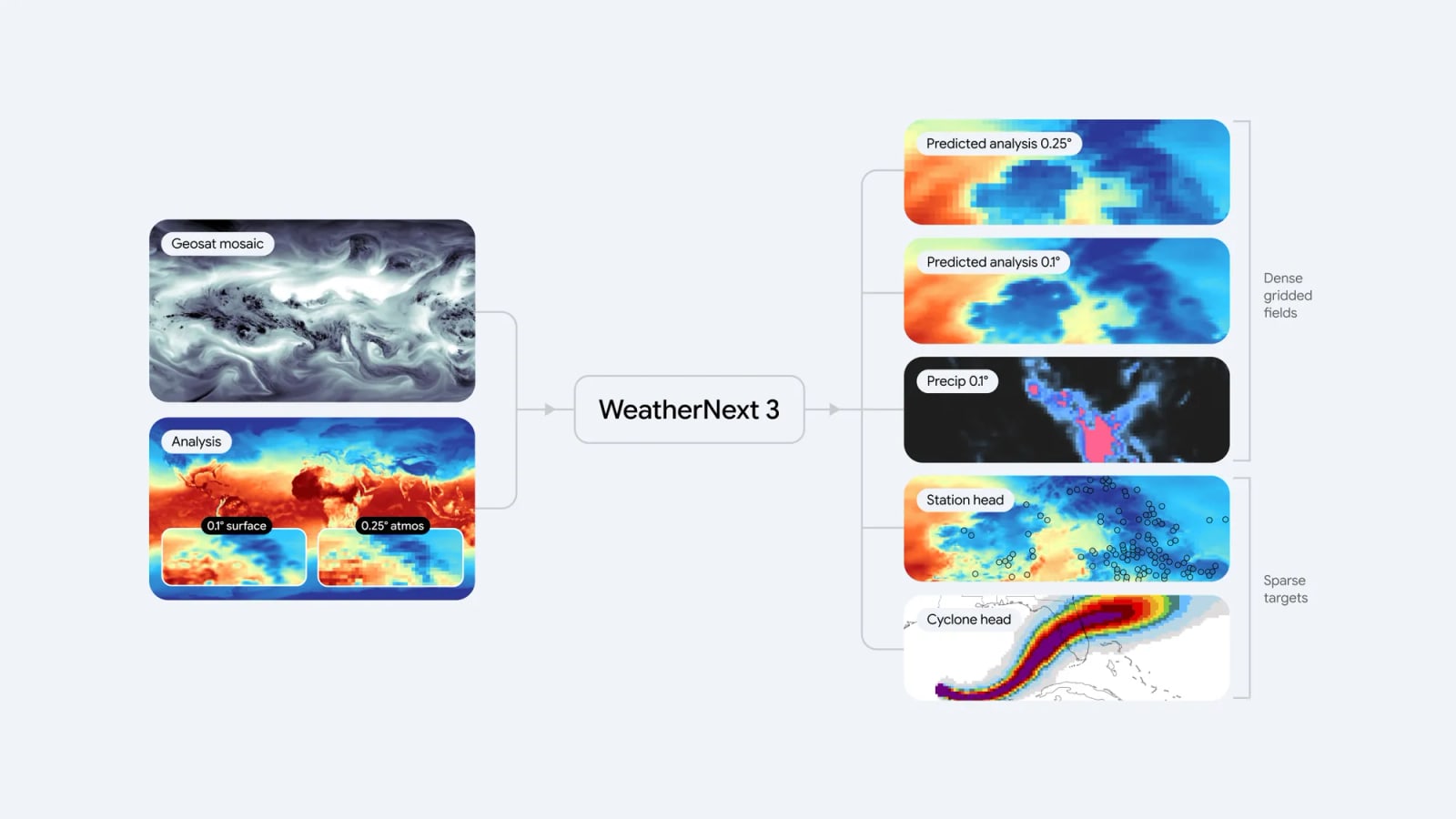
WeatherNext 3 is the latest weather model from Google DeepMind and Google Research. It combines recent geostationary satellite mosaics with historical analysis and produces a new forecast every hour. Its predecessor operated on six-hour increments, so the shorter cycle can reduce how long a prediction lags behind a quickly developing storm.
Google's official introduction describes 5km grids for surface temperature and moisture, 10km for other surface variables, and 25km for atmospheric fields and wind. That does not guarantee a street-level answer. Grid size describes model output, not certainty at one address.
Where WeatherNext 3 will appear
Google says the model is beginning to power weather information in Search, the Gemini app, Google Maps and the Maps Platform Weather API. Data is also available to researchers and businesses through BigQuery, Earth Engine and Cloud Storage. Rollout can differ by region and product, so interfaces will not necessarily change for everyone at once.
More frequent updates can make Maps more useful before a journey. In Gemini, value still depends on whether the answer retrieves current weather data and preserves its source. Our guide to RAG and source-based AI answers explains why fresh information alone cannot prevent a generated response from making mistakes.
What 50 percent more accurate actually means
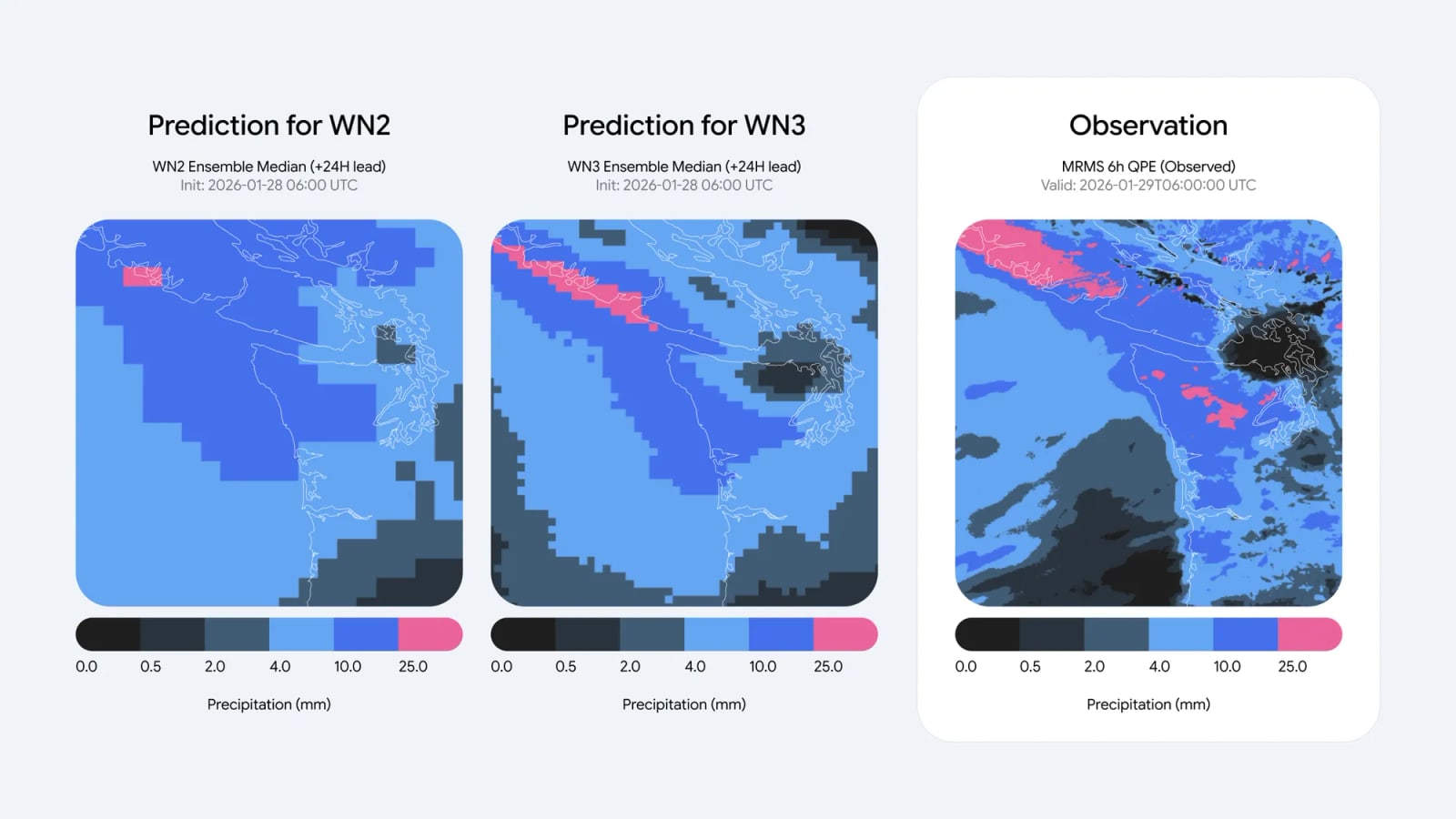
Google says precipitation forecasts one day or more ahead can be up to 50 percent more accurate, with particularly large gains in data-sparse regions. That is a result from the company's evaluation rather than a promise that every forecast improves by half. Performance varies by location, lead time and metric.
Published examples also show finer precipitation detail than WeatherNext 2. Smaller pixels can still place rain incorrectly or miss its intensity. Official weather services and emergency alerts remain the right source for safety-critical decisions. This is a stronger consumer forecasting system, not a replacement for civil protection or professional judgement.
A useful upgrade, not a crystal ball
The clearest advance is the combination of hourly refreshes and sharper spatial detail. Weather embedded in everyday products can respond sooner to recent changes. It cannot remove the atmosphere's inherent uncertainty or turn a probability into certainty.
Reading the metric, grid and data source matters whenever a model is presented with a dramatic percentage. Our artificial-intelligence dictionary separates models, training data and the final product a person actually uses.
The conversation starts here
Sign in with a supporter account to comment. Sign in


Nobody has commented yet. Want to go first?