
The pause starts at 50MW, but there are plenty of exceptions
New York has paused state environmental permits for new or expanded data centers capable of using at least 50 megawatts. Executive Order 62, signed by Governor Kathy Hochul on July 14, allows the hold to last up to 12 months while the state writes common rules for power, water, emissions and noise.
This is not a blanket shutdown. It applies to discretionary state applications that were still pending and had not been deemed complete. Local permits remain available, operating sites are unaffected, and exemptions cover academic, medical, quantum and semiconductor research as well as the public Empire AI consortium. A 50MW facility running flat out would use about 438GWh a year, although real consumption depends on how fully it is occupied.
A separate bill passed by the state legislature uses a 20MW threshold. It is not the same measure, and Hochul has not signed it. The order already in force starts at 50MW and reaches only permits controlled by the state.
Twelve gigawatts of data-center requests are waiting for the grid
The order points to nearly 12GW of data-center load requests in New York's interconnection queue, with more than 8GW added during 2025 alone. Those requests are not guaranteed buildings: projects may overlap, shrink or disappear. Grid planners still have to test whether the system can serve them without squeezing homes, factories and transport electrification.
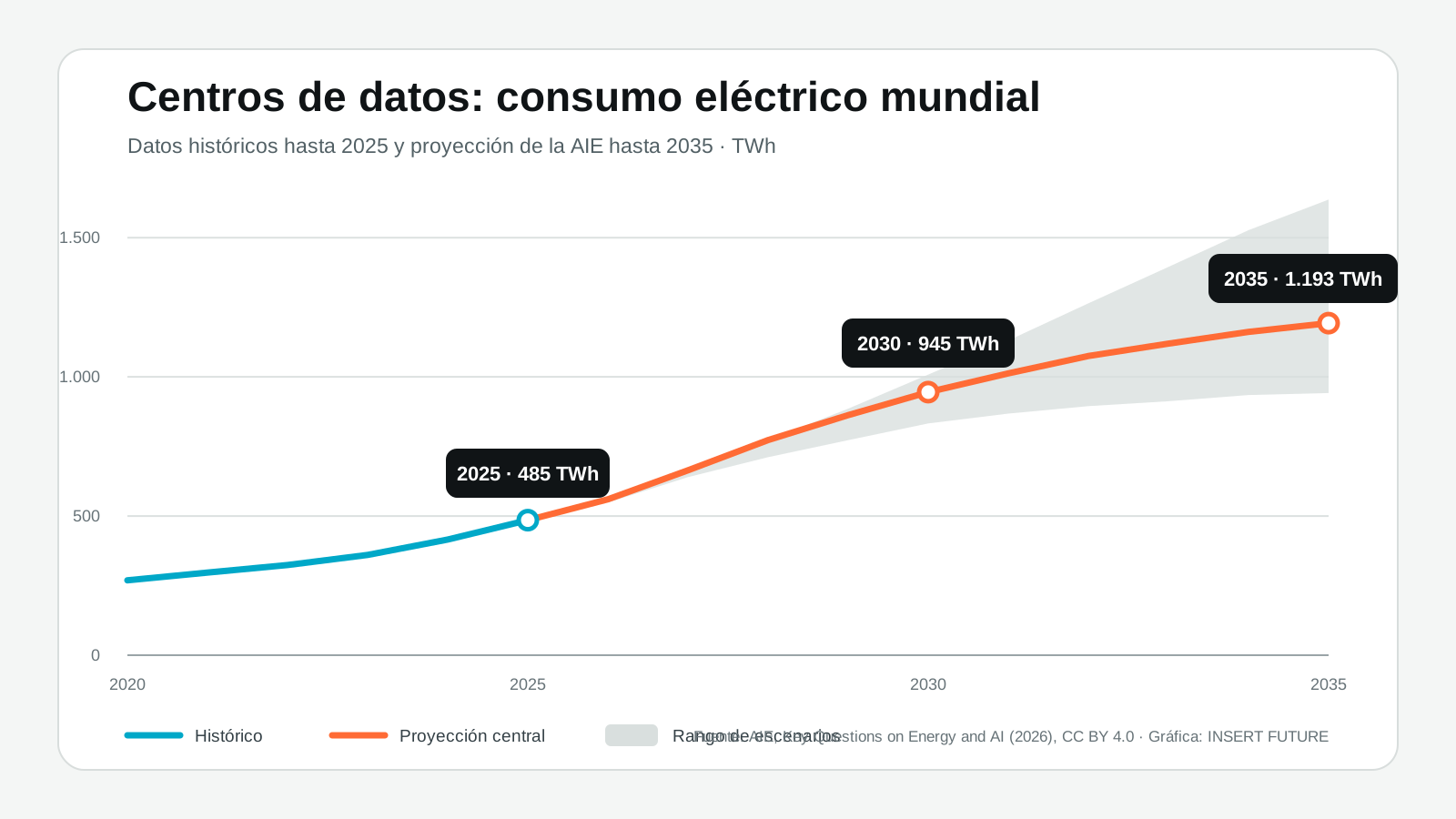
The scale becomes clearer outside New York. The International Energy Agency estimates that data centers used 485TWh in 2025 and could approach 950TWh in 2030, with AI-focused facilities tripling their demand. The awkward part is speed: a data center can be built far faster than a power plant or transmission line.
Even open AI projects need enormous machines: Alpha Chat runs on a Swiss public supercomputer. The useful questions are where a system runs, how much it consumes and who pays for the infrastructure needed to connect it.
New York does not want residents to pick up the entire bill
The one-year pause gives New York time to complete a statewide environmental review. Instead of treating each campus as an isolated project, the Department of Public Service will examine the combined effect on the grid, rates, water, air quality and noise. Developers may continue preparing applications, but the Department of Environmental Conservation will not decide the permits covered by the order until that framework is ready.
Hochul wants new facilities to pay up front for enough clean generation and storage to meet their demand. The order also considers a Grid Acceleration Fund to finance interconnections and protect other customers if a speculative project walks away. No contribution formula or rate has been approved; these are proposals for the public process, not current charges.
Within 60 days, a working group must propose contributions to housing, childcare, schools and local infrastructure, alongside labor standards. Hochul also wants to remove the industry's state sales-tax exemption. The Data Center Coalition warns that investment and jobs may move elsewhere. That is the argument New York now has to settle: how much can it demand without driving every project away?
Spain will eventually face the same question
According to the governor and Associated Press, New York is the first US state to impose a statewide pause of this kind on hyperscale data centers. Other places do not need to copy it line by line. The useful idea is to measure several projects together and decide which infrastructure costs belong to the developer rather than every ratepayer.
Europe has so far preferred efficiency and reporting rules. EU agency eu-LISA says data centers account for about 3% of the bloc's electricity demand and highlights heat reuse, lower water consumption and renewable power. Spain is competing for new campuses in Madrid, Aragón and elsewhere, so it will face the same question: how many can the grid take, and who pays to expand it?
The first New York proposals are due in two months. The water study and full environmental review may take a year. We will then know whether the pause created a more orderly path to construction or simply delayed the problem.
Where the information comes from
Original announcements, documents and reporting used to prepare this article.
01Gobernadora de Nueva York — anuncio oficial de la moratoria y marco comunitario02Orden Ejecutiva 62 — alcance, excepciones, plazos y umbral de 50 MW03Agencia Internacional de la Energía — Key Questions on Energy and AI04AIE — datos del consumo eléctrico mundial de centros de datos, 2020-203505Associated Press — contraste con la industria y otros estados06Inside Climate News — impacto ambiental y contexto legislativo07eu-LISA — eficiencia energética y peso de los centros de datos en la UEThe conversation starts here
Sign in with a supporter account to comment. Sign in

Nobody has commented yet. Want to go first?