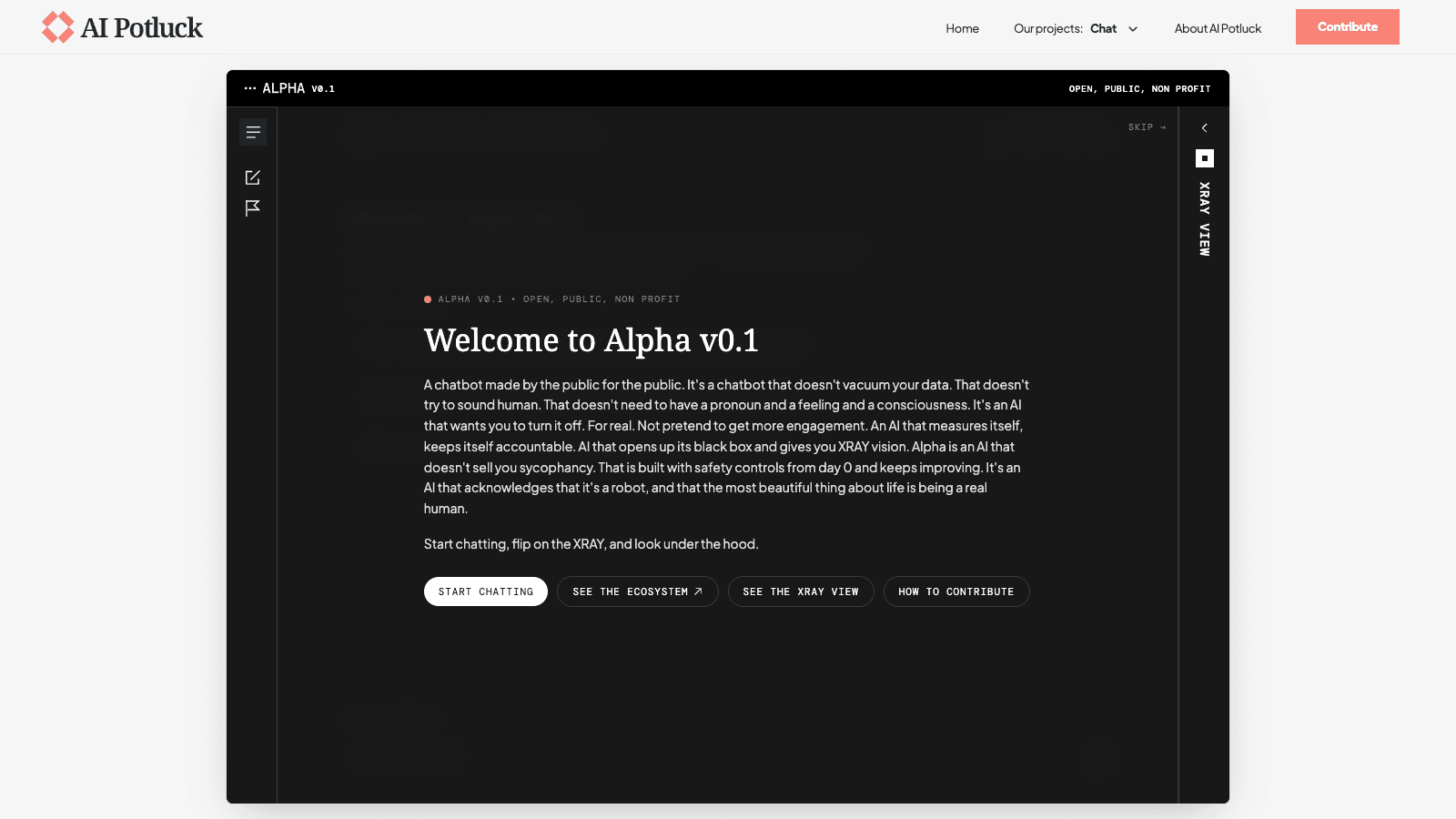
You can already try Alpha Chat without creating an account
Alpha Chat opens in a browser with no registration. It runs Apertus 70B, a model from the Swiss AI initiative, on compute provided by the Swiss National Supercomputing Centre. An XRay view is designed to show which parts of the system contribute to an answer.
The service says chats are automatically deleted after 30 days and never used for training. Its limits are visible too: web search is off, the interface is labelled v0.1 and several parts of the proposed architecture remain unfinished.
It is nowhere near matching every feature in ChatGPT, Claude or Gemini today. Its first goal is simpler: show that an assistant can be assembled from identifiable models, servers and tools without one company owning the entire service.
The point is not free access—it is being able to look under the hood
Current AI is a French non-profit backed by governments, foundations and companies. Its coalition includes Hugging Face, Mozilla, MIT Media Lab, Google DeepMind and Salesforce. It describes the result as a public-interest option rather than another commercial assistant.
A free chatbot can still pay for itself through advertising, data or a wider product business. AI Potluck instead wants the model, training data, code and surrounding tools to be open, with infrastructure distributed across multiple organisations.
Alpha runs Apertus 70B, whose weights, training data and recipes are published. The model covers more than 1,000 languages and its training process was designed to honour data opt-outs. Other teams can inspect it, find problems and deploy their own versions outside Current AI, although openness does not make the model infallible.
A second tool maps the pieces that open AI is still missing
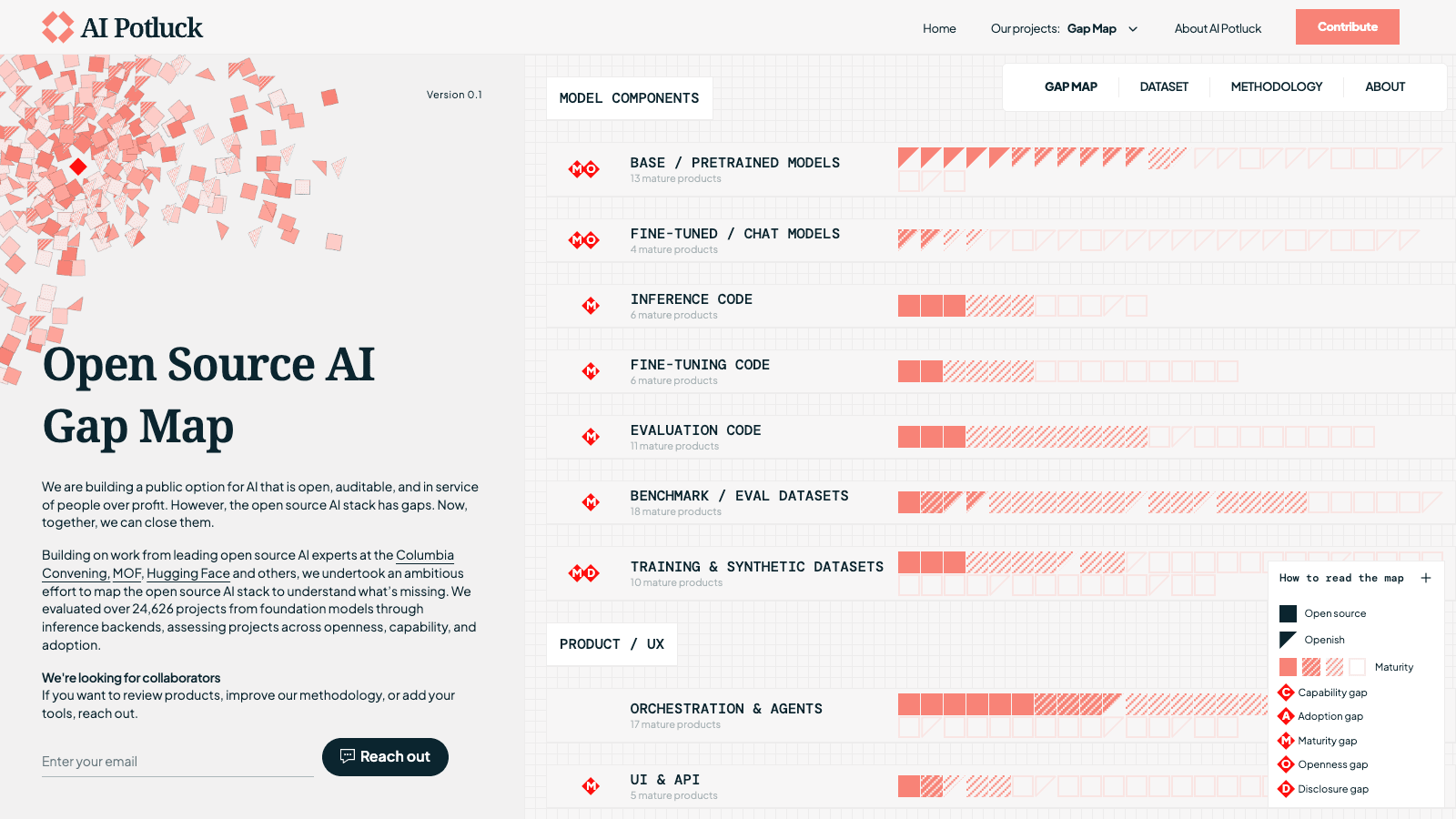
The Open Source AI Gap Map is the other product already online. Current AI tracked 24,626 projects and examined a much smaller subset in depth. Its method scores openness, adoption and capability while separating fully open systems from models that merely publish downloadable weights.
A weight file cannot reveal the complete training process, identify every data source or guarantee that a project survives a change of direction by its owner. We explored the same distinction in our report on Kimi K3's promised open release.
The map's MIT-licensed repository publishes its data, criteria and citations. Only several hundred products have detailed records, while more than 24,000 still need classification. It is a useful way to explore the field, not a finished census.
$400 million is pledged; $3.2 million has been awarded
Current AI says it has more than $400 million committed and wants to mobilise $2.5 billion over five years. France announced a €100 million contribution. That is far below frontier-lab spending, and a commitment is not the same as cash already deployed.
The first public grant round allocated $3.2 million to four projects in Kenya, Lebanon and the Brazilian Amazon. They cover African-language datasets, community-controlled Arab cultural archives, offline tools for Indigenous communities and AI auditing. The awards show a direction, but account for less than one per cent of the headline commitment.
Google DeepMind and Salesforce are helping to fund an alternative meant to reduce dependence on large technology companies. Publishing the code is not enough: Current AI will also need to explain who pays for each layer, what influence its funders retain and what happens if one leaves.
The real test comes in June 2027
The coalition aims to have an integrated prototype useful to public agencies, NGOs and developers by June 2027. Until then, Alpha Chat is evidence that the idea can be assembled, not that a public equivalent to commercial assistants already exists.
It still has to prove that responses are useful, demand can scale without runaway costs and the communities it wants to serve have real authority. Incident reports, external evaluations and access rules for public compute will matter as much as the interface.
A school, city council or charity needs to use the service, inspect it and switch providers without losing its work. Building Alpha Chat is the first step. Keeping it fast, affordable and useful when thousands of people arrive will be much harder.
Where the information comes from
Original announcements, documents and reporting used to prepare this article.
01Current AI — estrategia y lanzamiento de AI Potluck02Current AI — financiación y socios del proyecto03Current AI — primera ronda de ayudas por 3,2 millones de dólares04AI Potluck — Alpha Chat v0.105AI Potluck — metodología del Open Source AI Gap Map06Current AI — repositorio y datos del Gap Map07Swiss AI — ficha técnica de Apertus 70B08TechCrunch — entrevista con Ayah Bdeir y contraste de financiaciónThe conversation starts here
Sign in with a supporter account to comment. Sign in


Nobody has commented yet. Want to go first?