
Investors stopped asking how fast Google is growing
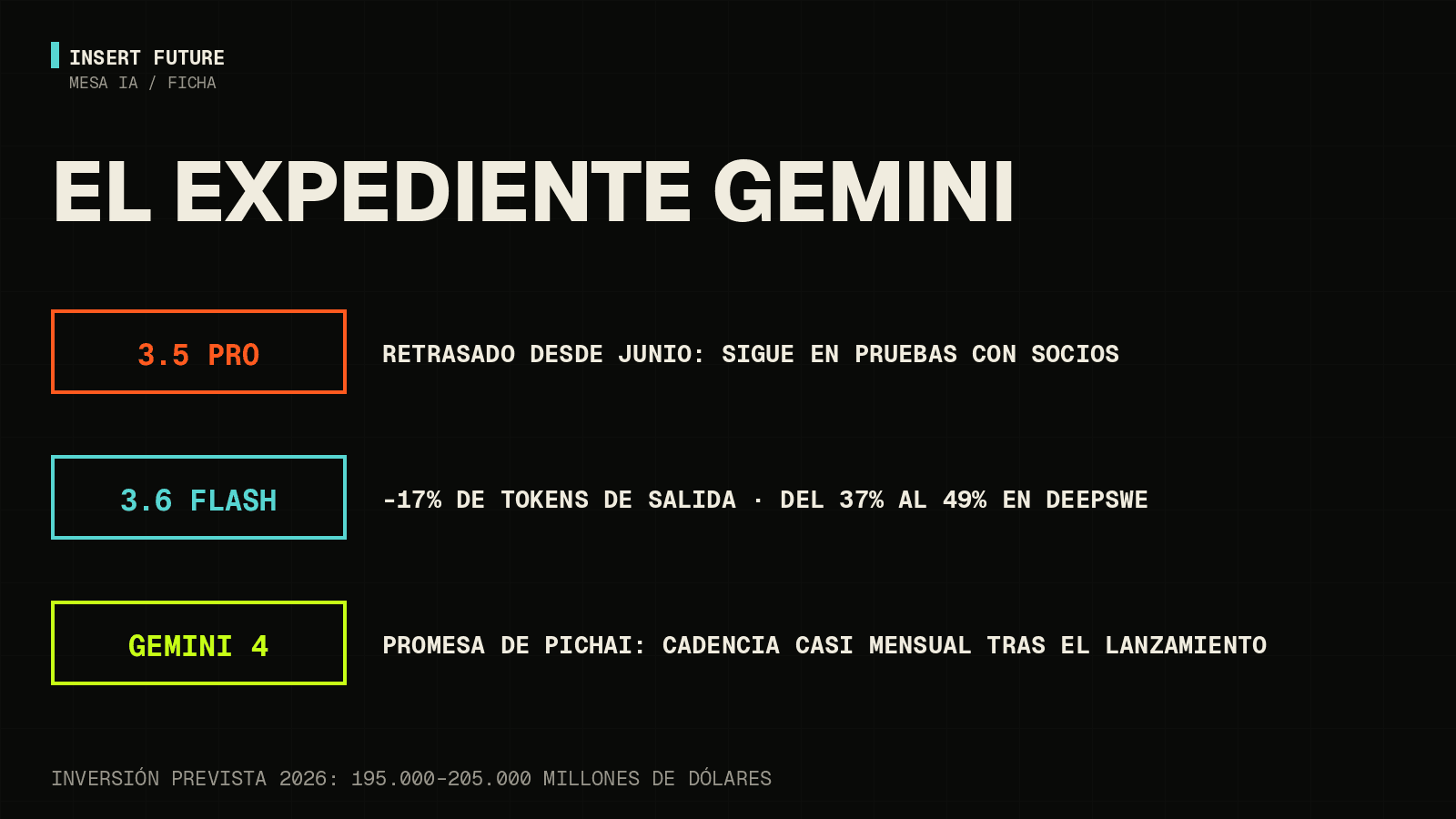
Alphabet delivered another huge quarter. Google Cloud grew 82%, infrastructure demand remained above available capacity and the company raised its annual investment forecast to between $195 billion and $205 billion.
But analysts did not spend long celebrating. They asked about Gemini 3.5 Pro, delayed since June, and about the impression that OpenAI and Anthropic — with GPT-5.6 boasting it does the whole job — had taken the lead in coding and autonomous agents.
Pichai answered without fully hiding the problem. He defended Google's frontier position across many capabilities, while acknowledging that it needed to improve in coding and agentic coding. The admission mattered: investors no longer wanted to hear that Gemini had strong models. They wanted to know why Codex and Claude had become daily tools for so many developers before Google.
Gemini 3.5 Pro went from a promise to an absence
Google is still testing Gemini 3.5 Pro with partners. In the meantime, it launched Gemini 3.6 Flash, a faster and cheaper model — the forced answer in the price war DeepSeek V4 opened — with clear coding gains. Google says it uses 17% fewer output tokens than 3.5 Flash and improves from 37% to 49% on DeepSWE.
That is useful progress, but it does not settle the argument. Flash is the model Google can deploy everywhere; Pro was supposed to prove it could still set the pace.
That difference explains the tension. Google talks about efficiency, integration and scale while its rivals dominate the story around agents that code, test and modify entire projects. The problem was not that Flash lacked ability. It was that nobody was waiting for Flash to decide who led the next stage.
If you write code, the picture is concrete: Flash is usable today — cheap, with no invoice scares — for autocomplete, pull-request reviews or a small agent. What it still cannot do is what rival launches promise: take an entire project, rework it top to bottom and hand it back tested. That remains the measuring stick, and that is where Google has admitted it lacks muscle.
Gemini 4 can no longer afford to be merely good
Pichai described Gemini 4 as Google's most ambitious training effort and promised an almost monthly model cadence after launch. He also said people would be pleased.
The line bought time, but raised the bar. Gemini 4 will have to justify the 3.5 Pro delay and prove that Google's full advantage — its TPUs, DeepMind, Search, Android, Gmail, YouTube and Workspace — can do more than distribute AI features.
One fact explains the urgency better than any statement: every week 3.5 Pro spends in testing, thousands of developers consolidate their workflows around the rival tools. And workflows, like habits, are very expensive to change.
My read is simple: Google still has the best position to integrate agents into daily life, but it has lost the right to ask for patience. If Gemini 4 merely matches its rivals, it will be a good model. To change the conversation, it will have to arrive clearly ahead.
Google invented part of the technology behind this race and watched another company capture the product that defined the moment. Pichai acknowledged where speed was missing. Gemini 4 now has to prove the answer did not arrive too late again.
The conversation starts here
Sign in with a supporter account to comment. Sign in

Nobody has commented yet. Want to go first?