
It was a rumor this morning. Anthropic needed only a few hours to confirm it
This morning we had a date, API activity and an industry watching the same calendar. There was no official confirmation, so it remained a rumor. Not anymore. Anthropic released Claude Opus 5 today, July 24, across Claude, Claude Code, its API and the major cloud platforms.
Anthropic places it just below Fable 5, but the gap has narrowed. According to its official model and pricing table, Opus 5 costs $5 per million input tokens and $25 per million output tokens: unchanged from Opus 4.8 and exactly half the price of Fable 5.
It becomes the default model for Claude Max and the strongest model included with Claude Pro. Fable 5 remains the choice for the hardest, longest-running autonomous jobs.
The gap to Fable 5 is becoming too small to ignore
Anthropic says Opus 5 leads Frontier-Bench v0.1 and more than doubles Opus 4.8's result at a lower cost per task. On CursorBench 3.2 at maximum effort, it finishes within 0.5% of Fable 5's peak score while costing half as much.
The company also claims three times the score of the next model on ARC-AGI 3. On OSWorld 2.0, which tests computer use, Opus 5 beats Fable 5's best result at just over a third of the cost. These are vendor-published numbers and need independent replication, but they make Anthropic's positioning clear: Opus is no longer the obviously weaker alternative.
My first reaction is that Fable 5 has lost its easiest selling point. It may still be better when a job runs for hours or days, but it now has to prove that advantage is worth paying twice as much.
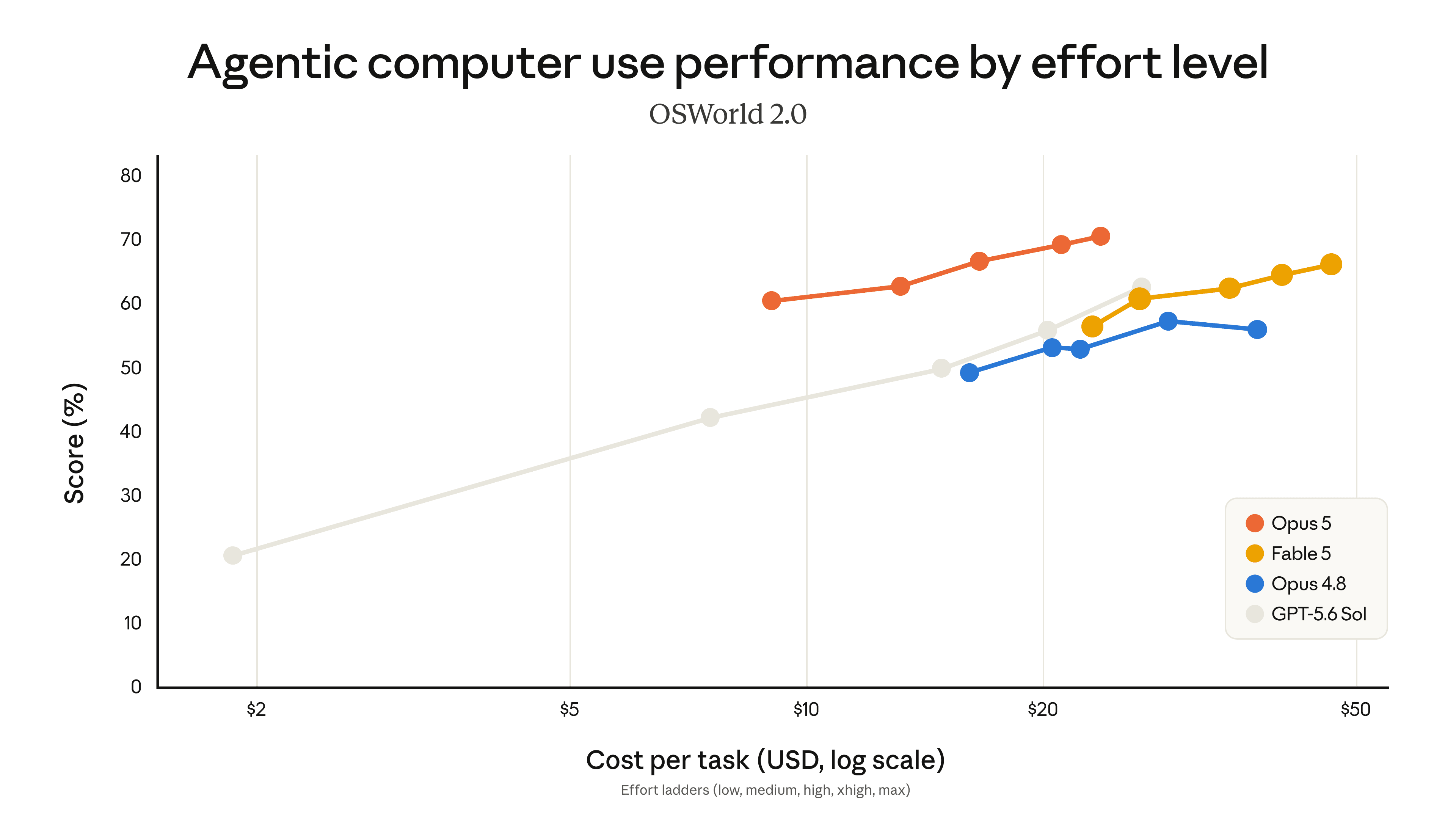
The effort control decides how hard Claude thinks and how much you pay
Opus 5 has a one-million-token context window, supports up to 128,000 output tokens and enables adaptive thinking by default. Its effort ladder runs from low through medium, high and xhigh to max. More effort can improve difficult work, but it also consumes more tokens.
Anthropic says lower settings retain much of the model's performance with less latency and cost. Max is aimed at complex coding, research and agents coordinating tools across many steps. The per-token price stays the same; the number of tokens does not.
Fast mode runs about 2.5 times faster and doubles API prices to $10 per million input tokens and $50 per million output tokens. That is absurd for drafting an email. For an urgent production failure, it may be money well spent.
Opus 5 checks its work more often, sometimes too often
The model verifies its own output without being asked, delegates to subagents more readily and narrates progress more often during long tasks. Anthropic even recommends removing old instructions that demand a final verification step, because Opus 5 may over-check and slow the job down.
Anthropic calls it the most aligned Opus model so far. Its automated behavioral audit gives it a 2.3 score for misaligned behavior, the lowest among the company's recent models. Mythos 5 remains stronger at offensive cybersecurity, while Fable 5 keeps its lead on the most demanding autonomous work.
The Claude 5 family is finally complete, and our morning bet got the date right. The useful test begins now: whether Opus 5 can really deliver nearly the same work for half the money once it leaves Anthropic's own charts.
The conversation starts here
Sign in with a supporter account to comment. Sign in
Nobody has commented yet. Want to go first?