

An idea turned into a list of numbers
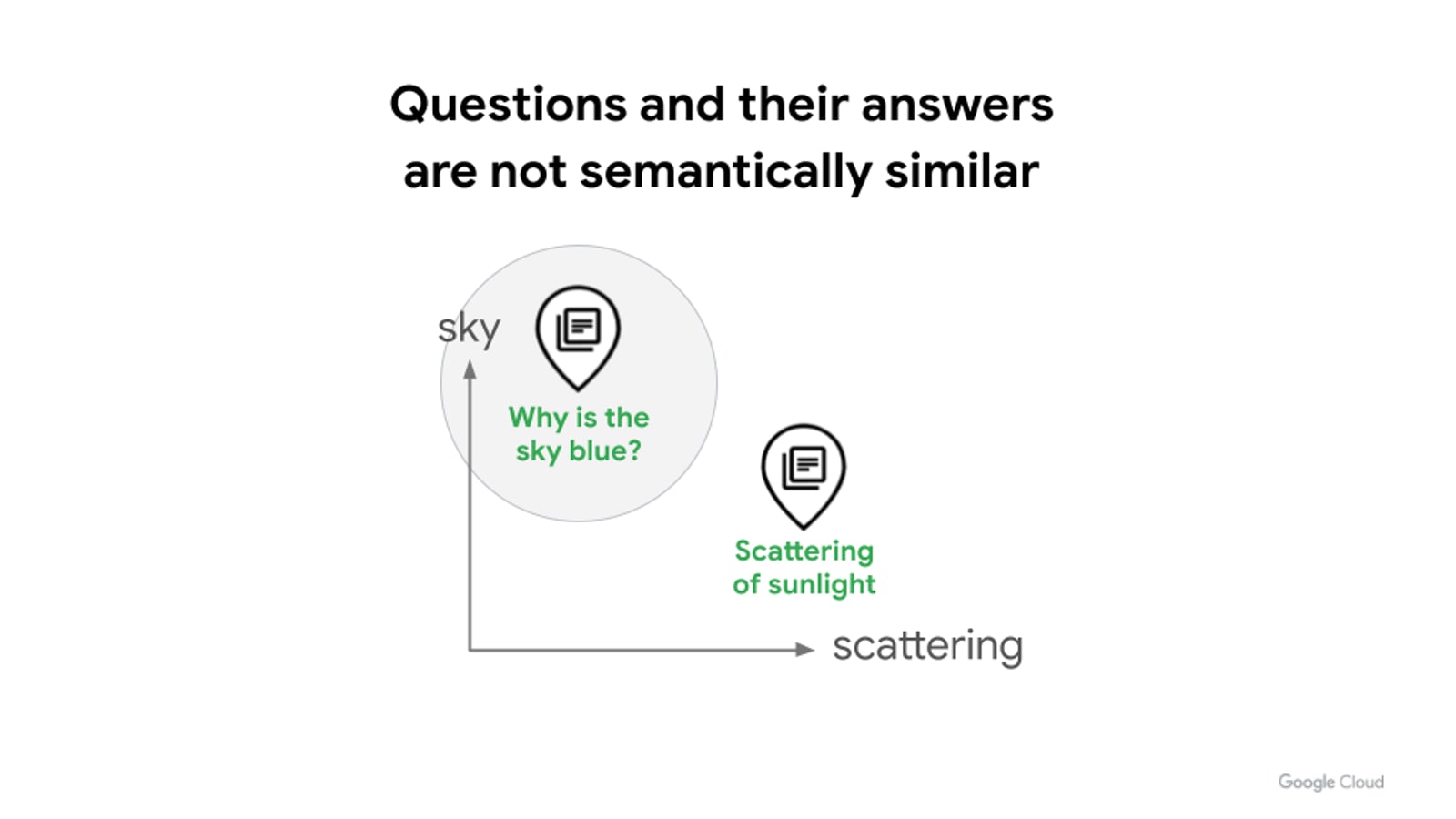
An embedding is a numerical representation of content. A model converts a sentence, image, song or code fragment into a vector, meaning an ordered list of numbers. Two items the model considers similar will normally sit close together in that mathematical space even when they do not contain the same words.
A query for a 'light laptop for travel', for example, can approach a listing that says '1.1kg computer with long battery life'. The match does not rely entirely on repeating laptop or travel. The model learned useful relationships during training and compresses them into coordinates a system can compare.
How closeness is measured
An individual number rarely carries a readable label such as colour, price or emotion. Information is distributed across many dimensions. Systems compare vectors using measures such as cosine similarity, dot product or Euclidean distance. The appropriate method depends on the model, its normalisation and the task.
Google's machine-learning course explains how embeddings reduce complex inputs into more manageable spaces. More dimensions do not automatically guarantee better results. Model quality, language, domain and training examples all matter.
Semantic search, recommendations and RAG
A shop can embed products and queries to find items by intent. A platform can recommend content near what a person already consumes. Teams can cluster thousands of documents, identify duplicates or classify messages without writing a rule for every phrase.
In a RAG system, embeddings help retrieve passages close to a question before a model generates the answer. A vector database stores and indexes those representations, but it is not the embedding itself. The vector is the data. The index is the structure that searches it efficiently.
Common embedding mistakes
Documents and queries must be transformed with compatible models. Changing the model without rebuilding the index mixes spaces that no longer mean the same thing. Task type also matters when a provider distinguishes queries, documents, classification and clustering. A smaller, faster vector may be enough, but the decision needs evaluation on real examples.
Closeness is not truth. A result can be semantically similar, outdated or owned by another user. Permissions, dates, filters and reranking remain necessary. Our artificial-intelligence dictionary places embeddings, tokens, context and models within the same conceptual map.
The conversation starts here
Sign in with a supporter account to comment. Sign in


Nobody has commented yet. Want to go first?