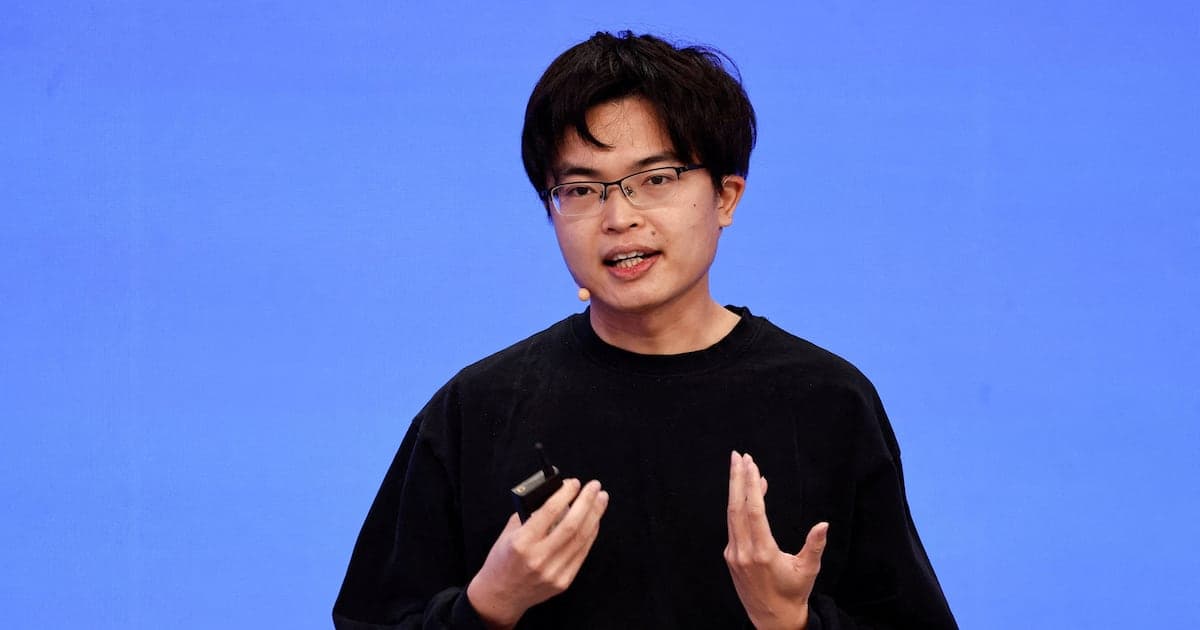
Kimi K3 went from threat to accused in less than a week
Kimi K3 had spent a few days doing exactly what Moonshot AI needed: entering conversations across Silicon Valley. The Chinese model arrived with 2.8 trillion parameters, a one-million-token context window and results close to the strongest systems from OpenAI and Anthropic. In some coding and web-design tests, it even challenged Fable 5 at a fraction of the price.
Then the conversation changed. White House technology adviser Michael Kratsios said the United States has information that Moonshot distilled Fable to train K3. The allegation, reported by Reuters, is serious. It also arrives without a public technical report that outsiders can examine.
Distillation is not copy and paste, but it is not harmless either
Distillation does not let a company open a rival model and take its parameters. The process is indirect: a powerful system generates huge volumes of answers and another model learns to imitate them. One acts as the teacher; the other tries to capture part of its problem-solving behaviour.
The technique is standard inside AI labs. Companies use it to create smaller, cheaper versions of their own systems. The dispute begins when somebody collects millions of a competitor's responses through fake accounts, intermediaries or uses forbidden by the service terms. At that point, an internal optimisation becomes a fight over ownership, access and competition.
Anthropic already had Moonshot in its sights
The suspicion did not begin with K3. In February, Anthropic accused DeepSeek, Moonshot and MiniMax of running large-scale distillation campaigns. Its report claims Moonshot generated more than 3.4 million exchanges with Claude through networks of fraudulent accounts, concentrating on coding, tool use and reasoning.
K3's visual performance added fuel. Two models trained to build the same website can produce similar structures because both know the same libraries, patterns and conventions. Seeing familiar cards or menus is not proof of copying. But when Moonshot is already under suspicion and K3 excels in one of Fable's strongest areas, the industry has reason to look more closely.

The claim comes without public proof—and with plenty of politics
No complete technical reconstruction of K3's training has been published. Moonshot has not admitted using Fable improperly. The accurate headline is therefore that the White House has made an allegation, not that the case is proven.
The political context matters. Chinese models are closing the gap, charging less and sometimes releasing downloadable weights. Washington no longer treats that as an ordinary business rivalry, but as a question of intellectual property, chips and national security. Moonshot may have broken the rules, and the United States may also use the case to support further restrictions. Both can be true.
There is an awkward contradiction here. Major labs trained their systems on enormous volumes of work published online, often without individual permission from authors, artists or publishers. They now argue that model outputs are strategic assets nobody should use to train a competitor. That does not legitimise whatever Moonshot may have done, but it helps explain why shared rules will be hard to write.
July 27 could make everything harder
Moonshot has promised to release Kimi K3's weights on July 27. If it does, researchers and companies will be able to download, modify and run the model without relying on a US API. Once copied across thousands of machines, removing it from the ecosystem would be practically impossible.
That is the scenario frightening Silicon Valley: spend billions building a closed model, then watch another lab absorb part of its capability and publish a cheaper, open alternative. K3 can be both an impressive Chinese engineering achievement and a model that learned from somebody else's outputs. Distillation does not remove the architecture, data, infrastructure and decisions required to build it.
We already explained why Kimi K3 had unsettled the industry. This accusation adds a more uncomfortable question. The next AI war will not be fought only over chips and source code: every model response can become a private lesson for the next rival.
The conversation starts here
Sign in with a supporter account to comment. Sign in
Nobody has commented yet. Want to go first?