Two gigawatts turn a chip order into national-scale infrastructure
We spend days arguing about whether Claude codes better than ChatGPT or whether Gemini has won another test. Beneath that contest sits a less elegant race: securing electricity, cooling and thousands of accelerators before everyone else. Anthropic has just reserved an enormous share.
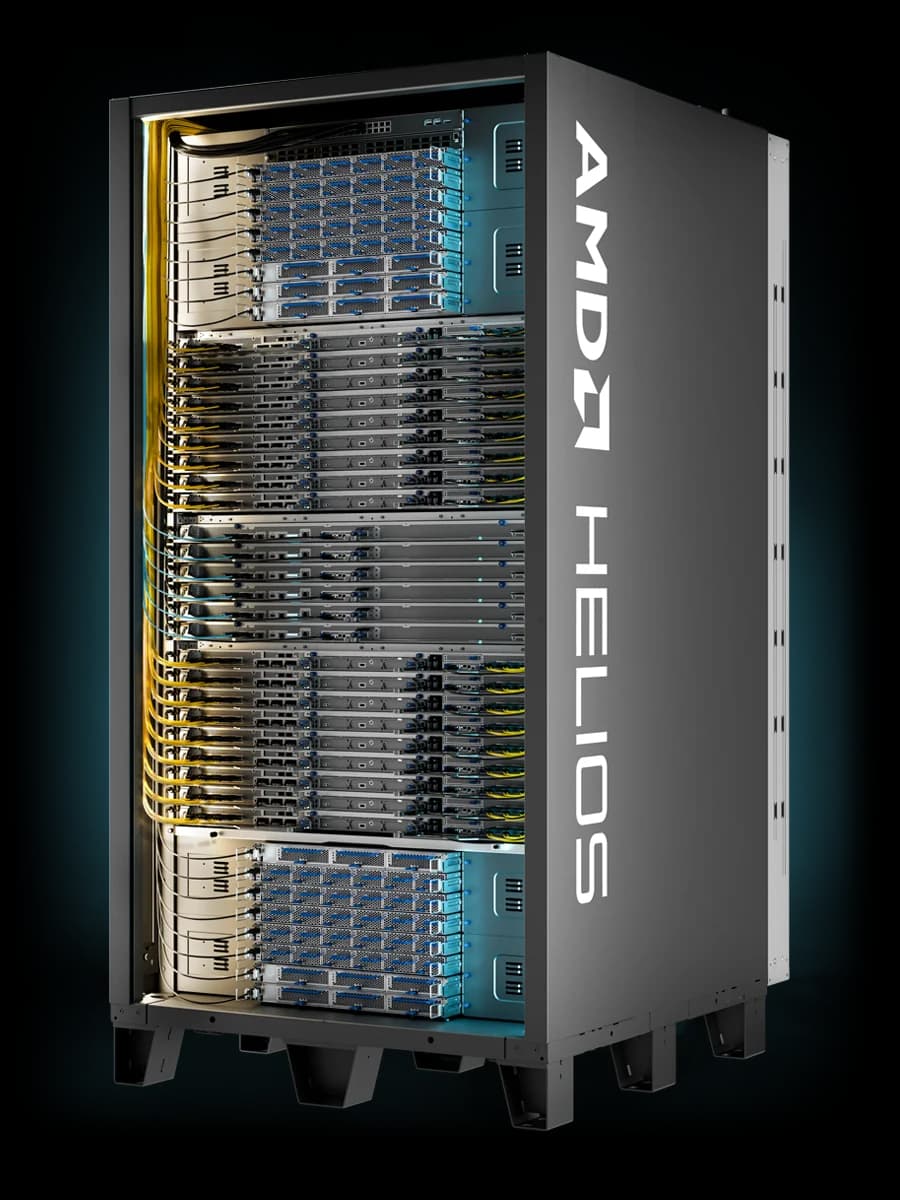
The company will deploy up to two gigawatts of AMD Helios systems powered by Instinct MI455X GPUs. The first gigawatt begins coming online in the first half of 2027. AMD has also committed to invest up to $5 billion in Anthropic as certain milestones are met.
A gigawatt is a unit normally associated with power stations, not computers. The finished deployment will not necessarily draw its full capacity every minute, but the scale explains why infrastructure belongs in our AI, security and power coverage. Frontier models are starting to resemble heavy industry.
Claude will help improve the software protecting NVIDIA
Anthropic is buying more than accelerators. The systems combine MI455X GPUs, “Venice” EPYC processors, Pensando networking and ROCm, AMD's answer to CUDA. Both companies will tune Claude's training and inference workloads together, while AMD adopts the assistant across engineering teams.
That is the interesting part. NVIDIA's advantage is not just fast silicon. CUDA is embedded in the tools, libraries and habits of AI labs. Moving provider can mean rewriting code and finding incompatibilities when every wasted hour costs a fortune.
ROCm has improved, but it still needs to prove it can carry frontier workloads without turning each upgrade into an afternoon of debugging. Anthropic's engineers optimizing Claude on AMD provide both a public test and a development partner. AMD has not merely sold boxes. It has recruited a demanding customer to help pave the road.
Anthropic is not leaving NVIDIA; it is buying room to manoeuvre
It would be tempting to say Claude is switching to AMD. It would also be wrong. Anthropic has major infrastructure relationships with Amazon and Google, uses several classes of accelerator and will continue spreading work across providers. Co-founder and chief compute officer Tom Brown offers the practical reason: diverse hardware lets the company place each workload on the right platform.
It also improves leverage. Depending on one supplier for the industry's scarcest resource is a poor negotiating position. OpenAI signed an agreement for up to six gigawatts of AMD capacity in October 2025; Meta added another six in February. Anthropic is not starting an NVIDIA exodus. It is joining a queue of customers demanding a credible second source.
NVIDIA's lead remains formidable. Its ecosystem, deployment experience and customer base do not vanish after three AMD contracts. Yet when OpenAI, Meta and Anthropic reserve capacity, the alternative stops being a decorative slide.
AMD is investing in the customer that will buy its machines
The deal has a circular turn: AMD may invest up to $5 billion in Anthropic, and Anthropic will spend an enormous sum on systems built around AMD. That aligns supplier and customer, while making it harder to separate organic demand from money circulating inside the same industry.
This is not an isolated arrangement. Infrastructure companies offer capital, guarantees and favourable terms to secure strategic customers. AMD needs recognisable models running on Helios. Anthropic needs capacity and competition among suppliers. Both want the deal to feel inevitable.
My reading is simple: NVIDIA will lead for a long time, but it can no longer dismiss AMD as the option mentioned for appearances. Our coverage of the race between major AI labs focuses on models; this partnership exposes who builds the ground beneath them.
The first gigawatt arrives in 2027. That is when we learn whether ROCm was ready for Claude — or whether AMD purchased an industrial-sized stress test.
The conversation starts here
Sign in with a supporter account to comment. Sign in

Nobody has commented yet. Want to go first?