An agent clicks a button. Qwen tries to predict what happens next
AI assistants can already write, code and answer questions convincingly. Agents have a messier job: they open websites, use tools, edit files and recover when a system behaves differently from the plan. Every action changes the scene. A folder gains a file, a page opens a new view or a command returns an error that changes the next decision.
Qwen-AgentWorld, introduced by Alibaba Cloud's Qwen team, is trained to predict that next state. It takes the interaction history and an agent's chosen action, then generates the response the environment should produce. Given a shell command, it recreates the terminal output. Given an action on a website, it simulates the state that should follow.
Any chatbot can be prompted to pretend it is a computer. Qwen-AgentWorld is different because action-to-result transitions have been part of its training objective from the beginning. Its main job is not conversation; it is keeping track of a task and responding like the digital environment another agent believes it is using.
Ten million journeys through terminals, websites and tools
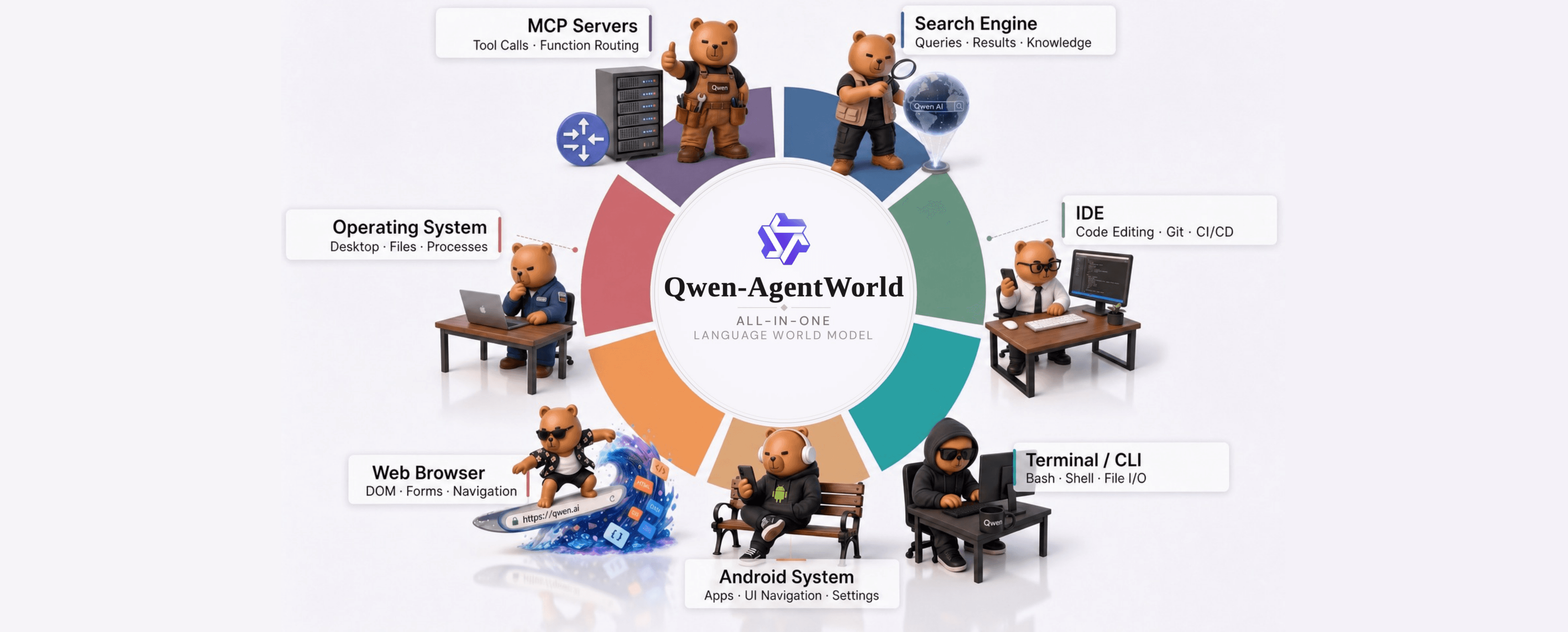
The technical report, submitted on June 23, describes more than ten million environment-interaction trajectories across seven domains: MCP-connected tools, search, terminals, software engineering, Android, the web and desktop operating systems. A trajectory may contain many steps, so that figure does not mean ten million separate computers or completed tasks.
Training has three stages. The first teaches broad patterns about how environments change; the second makes next-state prediction explicit; reinforcement learning then improves formatting, consistency and error handling. Alibaba can also inject controlled failures, paginated results, missing information and partly completed operations.
That control is the practical attraction. Training against a live account, database or code repository costs money and can damage real data. A simulator can repeat a difficult case thousands of times, alter one condition at a time and manufacture rare failures without putting production systems at risk.
There is an important limitation: the public checkpoint is a language model. Its files define visual components, but the model card says the released weights are language-only. Graphical environments are represented in text rather than understood pixel by pixel. That helps explain why Qwen's strongest results come from terminals and software engineering rather than user interfaces.
Alibaba built two sizes and released only one
Qwen-AgentWorld comes in two reported scales. The 35B-A3B model has 35 billion total parameters and activates about 3 billion per token. The larger 397B-A17B has 397 billion total parameters with about 17 billion active. Both use a mixture-of-experts architecture, calling on a small group of specialised components at each step instead of running the whole network.
As of July 19, the downloadable Hugging Face release is the 35B model. It carries an Apache 2.0 licence, supports a maximum 262,144-token context and works with Transformers, vLLM and SGLang. Qwen recommends keeping at least 128,000 tokens for long interactions, which still demands substantial GPU memory.
The 397B model appears in the paper, benchmarks and headline experiments, but its weights are not among the project's official downloads. Users can test the 35B checkpoint today; Alibaba's best reported numbers come from a much larger model that remains unavailable for independent deployment.
The 58.71 score above GPT-5.4 needs context
Alibaba created AgentWorldBench to compare environment simulation. It draws on real interactions by five frontier models across nine established benchmarks. Each predicted state is rated for format, factuality, consistency with prior state, realism and overall quality, then normalised to a 100-point scale.
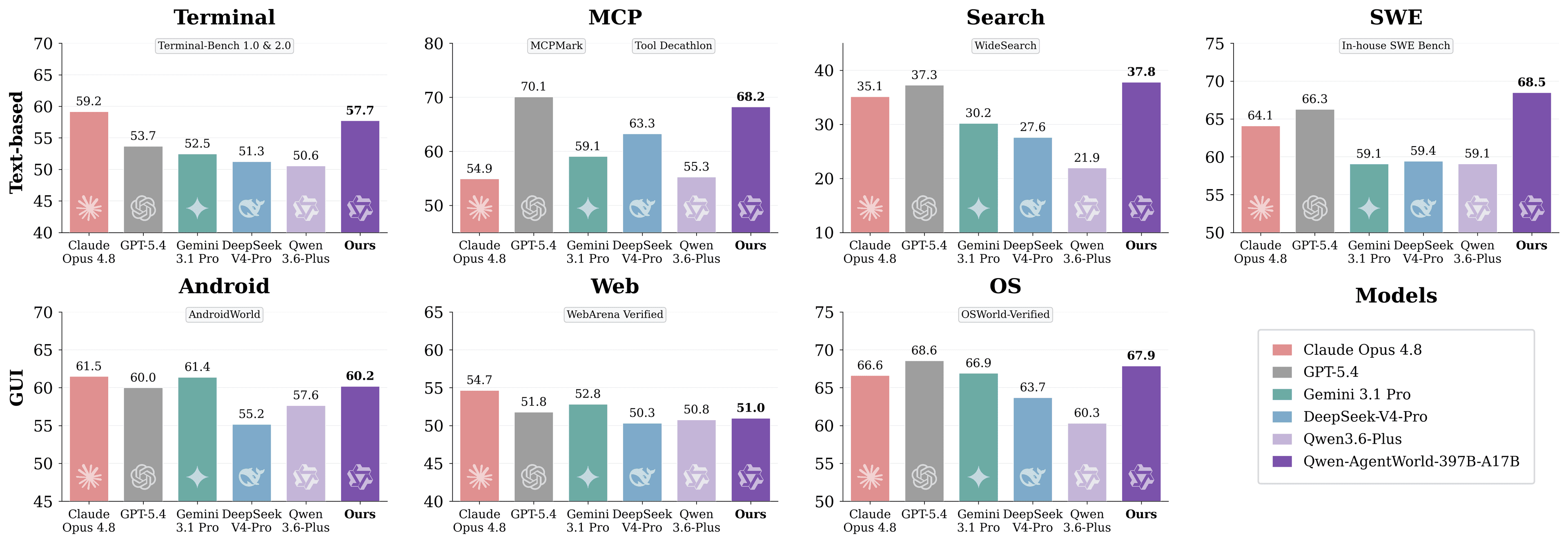
Qwen-AgentWorld-397B-A17B scores 58.71 in that evaluation against GPT-5.4's 58.25. Qwen leads by a more visible margin on Terminal, 57.73 to 53.69, and software engineering, 68.49 to 66.29. Across the three GUI categories, Claude Opus 4.6, Claude Opus 4.8, GPT-5.4 and Gemini 3.1 Pro all record higher combined averages. The public 35B model scores 56.39.
This measures a specialised task rather than overall intelligence. AgentWorldBench was built by the team presenting Qwen-AgentWorld, and its open-ended scores use GPT-5.2 as an automated judge. In the appendix's rule-based tests, GPT-5.4 leads both text and GUI tables. Qwen has not beaten GPT, Claude and Gemini at everything; it has produced a highly competitive result on the problem it was built to solve.
Agents improve after practising in invented worlds
The most consequential experiment turns Qwen-AgentWorld from a benchmark contestant into a training environment. Researchers generated 4,000 OpenClaw-style environments absent from the simulator's training data. Another agent practised in them for as many as 50 turns per task and was then tested on real benchmarks.
Claw-Eval rose from 65.4 to 69.7, while QwenClawBench moved from 47.9 to 55.0. Using the general-purpose Qwen3.6-Plus as the simulator produced little or no improvement. In Alibaba's study, a model trained specifically to represent environments created more useful practice than a conventional language model prompted to improvise one.
The search experiment went further. The team built one thousand fictional worlds containing 300-to-500-row databases, invented pages and internally consistent facts. Since no answer existed on the real web or in model memory, the agent had to search, open pages and combine sources. After training there, a 35B model improved from 34.02 to 50.31 on WideSearch's main real-world search metric.
These are vendor results and need independent replication. They also depend on a detailed starting state. Omit a permission, file or tool setting and the agent may learn from a world that differs from the system it will eventually use. A strong simulator offers cheap, controlled practice; a weak one can teach habits that later need to be unlearned.
An agent could rehearse before touching your files
Current agents can look excellent in a demonstration and fall apart when a button moves, an unexpected dialog appears or a tool returns a new kind of response. A world model could help during training by generating thousands of situations without thousands of real accounts. At run time, it could also compare likely consequences before committing to an action.
Imagine an agent asked to reorganise a working folder. It tests the plan in a simulated copy, notices that a path will break and revises the command. A retailer could rehearse a catalogue change before publication. A coding agent could predict which tests are likely to fail after changing a function. Qwen-AgentWorld does not make those workflows reliable on its own, but it makes the rehearsal process measurable and trainable.
Simulation does not replace permissions, backups or human confirmation. The world model can predict the wrong outcome, and an agent may trust that prediction enough to choose the worst option. The advantage is an opportunity to practise, not a magic guarantee that every action is safe.
Alibaba wants more of the AI stack
Qwen-AgentWorld fits a much larger plan. Alibaba now builds models, developer tools, agents, cloud services and its own chips. In March it formed the Alibaba Token Hub business group under chief executive Eddie Wu to concentrate its model-as-a-service effort. The company said in May that AI-related product revenue had grown at triple-digit rates for eleven consecutive quarters and reached 30% of Alibaba Cloud's external revenue.
An environment simulator can feed that entire catalogue: training Alibaba's own agents, producing exercises for customers and reducing the need for live infrastructure during learning. Releasing the 35B version also lets universities and companies test the approach without relying entirely on an Alibaba API.
The project still has to prove itself outside Qwen's lab, especially on visual interfaces and services that change every week. It has nevertheless posed a useful question for the next generation of agents: should they learn by making mistakes inside our real systems, or arrive after making those mistakes thousands of times in a copy? Alibaba has built the copy and wants its agents to start practising there.
Where the information comes from
Original announcements, documents and reporting used to prepare this article.
01Qwen — anuncio oficial de Qwen-AgentWorld02Qwen — informe técnico completo de Qwen-AgentWorld03QwenLM — repositorio, código, prompts e imágenes oficiales04Hugging Face — pesos, licencia y ficha técnica de Qwen-AgentWorld-35B-A3B05Alibaba Group — resultados y estrategia empresarial de inteligencia artificialThe conversation starts here
Sign in with a supporter account to comment. Sign in

Nobody has commented yet. Want to go first?